

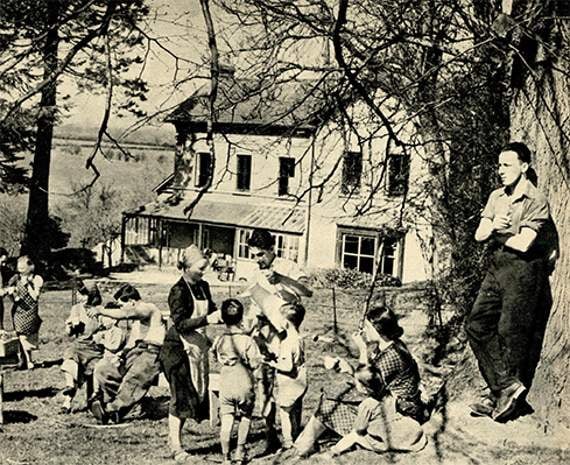
A FASCINATING article in the Brecknock Museum collection sheds light on a little-known aspect of Brecon’s past but also raises many questions.
“Illustrated magazine, published on May 29th 1939, has a four-page feature titled ‘Refugees with a Future’,” curatorial assistant Jacquie Morgan explains. “It’s about an Austrian family, the Krumböcks, who were forced to flee Vienna after the Nazi annexation of Austria in 1938. They came to the Society of Friends Agricultural Training Camp for Refugees at Tyn-y-Cae, near Brecon – a building many readers will know from its later years as a Youth Hostel.”
Leopold Krumböck owned a prosperous business in Vienna making artificial limbs and lived with his wife and three young children in a large house near the city. The business was confiscated by the Nazis and they had to flee the country. The article describes their life at Tyn-y-Cae.
“The article is interesting on so many levels,” says Jacquie. “Illustrated was a large-format magazine that came out every Wednesday and was part of the mid-20th century mass media.
The photos are typical of the period with one showing the family standing closely together, looking into the distance, as if looking ahead to their future. From a local history viewpoint, it’s valuable to see photos of Tyn-y-Cae inside and out, with rural skills being taught there. For example, Mr Krumböck is shown making a beehive.”
In 1939 there were about 80,000 refugees living in Britain. Visa applications were only allowed from adults who were financially self-supporting, had an offer of work, or had a £50 guarantee from a British benefactor. “This is where the support of the Society of Friends, or Quakers, was so important,” adds Jacquie.
“There were only around 20,000 Quakers in Britain in the 1930s but nearly every Quaker household contributed towards refugee relief in some way.
“Tyn-y-Cae was one of several Quaker camps in which 220 refugees were provided with board, lodging and training in agriculture to assist them in finding work. Many emigrated afterwards but the article says some stayed on.”
The Quakers were awarded the Nobel Peace Prize for their work with refugees and relief in 1947.
Today, local Quakers are part of the Southern Marches Area Quaker Meeting (SMAQM), which stretches from southern Herefordshire to mid-Shropshire and mid-Wales. A Meeting for Worship takes place three times a month at The Muse in Brecon.
Did your family have any connection with the Agricultural Training Camp for Refugees at Tyn-y-Cae, meet any of the refugees, or know what happened to them?
Who trained the refugees in agriculture and rural crafts? The article says there was a “woman warden” in charge and a picture shows the refugees being taught English by a gentleman with a beard: does anyone know who those two people were?
Jacquie adds: “We’d really like to find out more about this under-researched part of Brecon’s history.”
Anyone who can help Jacquie should call her on 01874 624121, or email her at [email protected].