

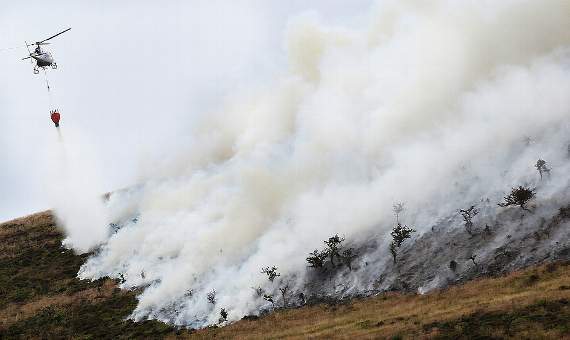
A CLIMATE change expert has described parts of the Brecon Beacons as looking like the African savannah recently, after Mid and West Wales fire service reported a big spike in grass fires caused by people in 2018-19.
Professor Stefan Doerr of Swansea University has warned that changing weather patterns are helping to fuel “tinder box” conditions in mid Wales.
Driven in part by last year’s prolonged, hot summer, there were 2,850 of these grass fires across Wales compared to 1,627 the previous year.
Prof Doerr said Wales had a lot of unmanaged land covered by grass, bracken and gorse.




“Parts of the Brecon Beacons over Easter looked like the savannah of southern Africa,” he said.
Prof Doerr added: “It is difficult to reduce human-caused ignition, although the fire service has been very proactive.”
Prof Doerr said almost all grassfires in Wales and the UK were started by people, whether deliberately or not.
“The problem is identifying the source,” he said.
In other parts of the world, Prof Doerr said lightning strikes were the main cause.
He said the evidence in Wales was that the fire services were better at dealing with grass fires, but the ones that gathered strength were more severe and burned larger areas.
“Environmental conditions are causing real problems,” he said.
Prof Doerr explained that the UK and the northern hemisphere more widely were experiencing more periods of prolonged, dry weather.
Sweden experienced major wildfires last summer, he said, due to a high pressure system that just sat over the country.
Prof Doerr said these changing weather patterns were being caused by the Arctic warming faster than the equator.
The effect of this reduction of the temperature difference, he said, was a slowing down of the jet stream – a river of fast-moving air which transports weather systems across the Atlantic to Europe.
“The jet stream has less energy,” said Prof Doerr. “Because of this, it meanders more, like any river.
“High pressures get stuck. And low pressures get stuck for longer, and that can increase flooding.
“We are seeing more of these high pressures in spring, when we still have dead grass (from the winter).”
Combine this with hot weather, he said, and “tinder box” conditions are created.
While changing weather patterns may seem an insurmountable issue, Prof Doerr said action could be taken to lessen the risk and severity of grass and wildfires in Wales.
“We should generate more fire breaks,” he said.
This would involve controlled burning of narrow strips of land to prevent fires spreading.
Landowners and farmers are allowed to carry out controlled burns on their land between October and March, but only if they have created a specific plan for starting and containing the fire.
Prof Doerr said this sixth-month window was rightly designed to protect nesting birds, but added: “It would be really useful for this to be extended to burn small strips of grass to create fire breaks.”
He added that planning regulations could place more emphasis on reducing the availability of fuel for grass and wildfires near people’s homes.
The authorities put a major effort into tackling arson in 2015, via Operation Dawns Glaw.
This operation has been credited with the reduction of deliberate grass fires in Wales prior to the recent increase.
The man behind the operation, Mydrian Harries, of Mid and West Wales Fire and Rescue Service, said: “Due to substantially less rainfall during the early months of the year (2018-19) and a significantly drier summer, factors outside of our control have had a negative impact on the statistics.
“When you compare 2017-18 against 2018-19 across Wales, we attended 230% more incidents of deliberate grass fires in June, 739% more in July, 198% more in August, 167% more in September and 114% more in October.
“While these statistics are very disappointing, they should not take away from the overall success of Operation Dawns Glaw.”
He added: “History shows that engaging with young people through targeted interventions, high visibility patrols in vulnerable areas and education and marketing of safety advice, works.”
If you see anyone deliberately setting a fire, phone police on 101 or contact Crimestoppers on 0800 555111.