

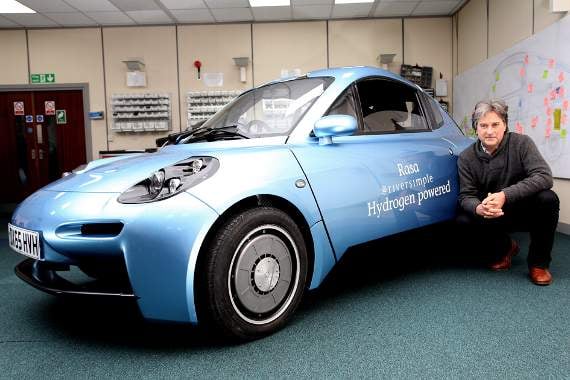
LLANDRINDOD Wells business-man Hugo Spowers has said joining the Prime Minister on a trade trip to China earlier this month will be a boost for his business.
Mr Spowers, the man behind Riversimple which is developing a hydrogen-powered car, was one of 49 businessmen who took part in the “whistle-stop tour” of three Chinese cities.
Mr Spowers flew out with the party in the RAF’s ‘Voyager’ airbus. He said the group, accompanied by ministers and members of the media, stayed just two nights in China and managed to visit three cities, Wuhan, Beijing and Shanghai.
The trip was organised as the UK Government seeks to explore Britain’s trade options ahead of this country’s departure from the European Union.

He said: “It was a bit of a whistle-stop tour in that we had such a demanding schedule.
“There were several ceremonies and lots of speeches so we didn’t perhaps get the one-to-one time with the people in China we wanted to, but I’m sure it’s helped raise Riversimple’s profile.
“The Prime Minister came back to the ‘second-class’ seats, where most of the businessmen were seated, to chat to us during the flight out and on the way back. It wasn’t long enough to be a particularly meaningful conversation but it was a nice gesture and she didn’t have to do it.”
Mr Spowers said he did have a “meaningful” chat with international trade secretary Dr Liam Fox and made contacts with the other British businessmen as well as meeting the head of Shell in China.
During the visit to Wuhan, the Chinese institute there which Mr Spowers had already been in negotiations with were very keen to tie up a licensing deal for the Rasa there and then.
The Rasa is the brand name for the hydrogen-powered vehicle which Riversimple are due to start trialling this summer in Abergavenny.
“Ultimately we couldn’t get it all agreed while I was in China because of all the documentation that needed signing. I think they were very keen to get the deal signed while the Prime Minister was out there and I’m confident we’ll get it done in the future.”
He added: “China has recently introduced very significant subsidies to bring hydrogen vehicles to market and we’ve had a number of approaches over the last few months.
“As far as we know we are the only independent hydrogen fuel-cell car company in the world. As a start-up we have the advantage of having a clean sheet of paper and designing our car around the technology. This makes it much more efficient and much cheaper to bring to market.”
He said the Rasa, which is fun to drive and cheap to power, should be on the market by 2020.
The car is intended for the majority of journeys which take place within a radius of about 25 miles of people’s homes. The car’s successful launch will be reliant on people changing their fuelling habits as it relies for its power on hydrogen produced from natural sources of energy such as landfill gas.
It will also require a revolution at the petrol pumps with hydrogen being available alongside petrol and diesel. Rather than buy the car people will agree a “sale of service” contract with the supplier which will include fuel costs, insurance, road tax and maintenance. The estimated cost of running the hydrogen car would work out at roughly as much as it currently costs to run a diesel-powered VW Golf.