
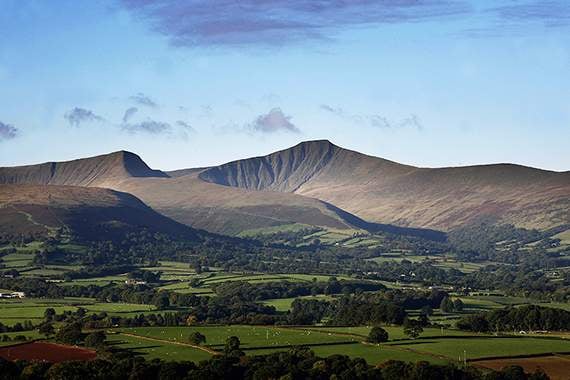
THE basis on which national parks are protected has been overlooked in a Welsh Government-backed review, politicians have said.
Opposition members of the Welsh Assembly have complained a review of national parks and areas of outstanding natural beauty (AONBs) set up by the Welsh Government failed to mention a piece of law known as the ‘Sandford Principle’.
That says when there is a conflict between people enjoying a national park and the park authority’s duty to protect the natural beauty, wildlife and cultural heritage of the area it is conservation that takes priority.
AMs, who debated the report in the Senedd last Tuesday, said they feared extra protections for national parks, including the Brecon Beacons, could be lost.




Plaid Cymru AM for Mid and West Wales, Simon Thomas, the party’s shadow rural affairs secretary, said: “It is a concern that the Future Landscapes report contains no reference to what should happen when there is conflict between the conservation and enjoyment aspects of a national park. “Currently the law dictates that conservation should takes precedence.
“This is known as the Sandford Principle. By not even addressing this principle, the report leaves open the possibility that development could be allowed in our national parks and areas of outstanding natural beauty that could detract from the purpose of their designation in the first place.”
UKIP’s Mid and West Wales AM Neil Hamilton told the Senedd he feared the report produced by the Welsh Government commissioned working group could lead to windfarms in national parks.
The report, presented by a working group led by Lord Dafydd Elis-Thomas, also said the Brecon Beacons National Park and other park authorities should promote green, or sustainable, energy and Wales should use such areas as brands to portray a positive image of the country to the world and to attract inward investment and tourism.
Mr Hamilton said: “What is the point of designating areas as being of outstanding natural beauty or as national parks, if not to give precedence to the principle of conservation?”
He claimed increasing renewable energy production in Wales would be pointless.
“With India and China between them building another 800 new coal-fired power stations, what use is it to desecrate our wild places in Wales in order to make such a minute contribution towards the reduction of carbon dioxide emissions that it can have no practicable effect on the climate whatsoever? So, I would make a plea in this instance, even for those who take a very different view to me on man-made global warming, to make an exception to the general approach in order to protect our wild areas in mid Wales, north Wales and west Wales in particular.”
Conservative AM Suzy Davies also said she feared the report could allow “disproportionately intrusive infrastructure in the name of green growth.”
Tory David Melding also said he believed the Welsh Government should make a clear statement on the Sandford Principle.
He said: “I think conservation is at the heart of these areas being highly popular tourist destinations, as well as recreational areas of outstanding popularity, with three quarters of us visiting a national park at least once a year.”
Labour’s Mid and West Wales AM Eluned Morgan said she was concerned current legislation to conserve national parks hinders their secondary duty to promote economic and social development.
She said: “We mustn’t forget that these national parks are living places. There’s a residential population of over 80,000 people. We need to make life easy for the people working there so we don’t lose more young people to the bright lights of the cities.
“Now, national parks make up around 20 percent of the land area of Wales. They cannot and must not be pickled in aspic. They need to be vibrant communities where different generations can live and work, and, of course, we must do that as far as possible whilst preserving the beauty of the environment.”
Cabinet secretary for the environment Lesley Griffiths said an earlier report, which the working party had considered, had considered enhancing the Sandford protections. She said other laws brought in by the Welsh Government have protected the environment and suggested protections could be increased.
Ms Griffiths said: “These firm principles, combined with the proposals by ‘Future Landscapes’, have, I believe, the potential to be a Sandford plus plus.”
She said any legislation to make changes to how national parks are governed would have to be brought forward in legislation through the Assembly.
AMs approved the government’s motion that the Future Landscapes report be noted with a Plaid Cymru amendment that any changes to legislation governing national parks should be taken through the Assembly as primary legislation.
A Plaid Cymru motion expressing regret the report hadn’t dealt with the Sandford Principle was defeated.
An online petition on the 38 Degrees website has attracted more than 9,000 signatures in support of retaining the Sandford Principle.
During the debate Ms Griffiths also reminded members she is currently consulting on a proposal to reduce the membership of the Brecon Beacons National Park Authority. She said she would make a decision on the next step for the Brecon Beacons authority when the consultation closes at the end of this month.