
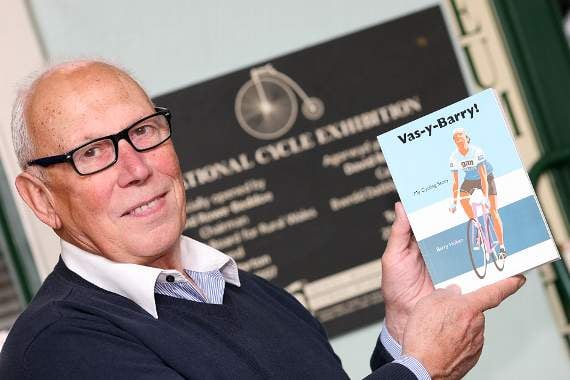
THE National Cycle Museum in Llandrindod Wells marked its 20th anniversary on March 21 by inviting one of British cycling’s most accomplished riders to conduct a book signing at its premises in the Automobile Palace in Temple Street.
The museum threw open its doors to cycling fans who flocked from far and wide and cut a cake to mark the anniversary as well as the 93rd birthday of Len Mason one of the eight trustees who run the charitable trust that looks after the vintage bicycle collection. Balloons festooned the entrance to the museum, while the museum waived its normal entry charges.
A tri-tandem sat in the lobby area of the Automobile Palace, enticing visitors to look inside at the assorted collection of vintage bicycles and tricycles that the museum’s dedicated staff have built up over the two decades that the charitable trust has been in operation.
Barry Hoban, the former Tour de France rider who now lives in Newtown was the guest visitor who was happy to chat with cycling enthusiasts about his career and sign copies of his book entitled Vas-y-Barry!, which translated from the French means Go on Barry!, that they queued up to buy.

It charts his astonishing 19-year career as a professional biker rider based in France and then Belgium in the 1960s and 70s. He was one of the pioneers on the British cycling scene who headed for the continent to turn professional at a time when riders from these Isles rarely ventured overseas.
Barry was only too happy to take on the cake-cutting duties after being tracked down by museum curator and trustee Freda Davies and invited to attend the celebrations of the museum’s landmark birthday.
Freda found out that Barry lived in the small village of Mochdre, near Newtown, less than 25 miles from Llandrindod Wells, with a dogged piece of detective work that led her to spot his photograph on the Facebook page of Newtown-based Hafren Cycling Club. After posting a message to Barry, she was contacted by his publicist Christoper Sidwell and the idea of a book signing was hatched.
Freda said she was delighted Barry could turn up for the anniversary celebrations, while Jon Williams, the Mayor of Llandrindod Wells, was another VIP visitor. She explained that the National Cycle Museum was launched on March 21 1997. It was set up by businessmen David Higman who took out a lease at the Automobile Palace of an area previously used as a workshop where he chose to display his own private collection of about 100 bicycles to the public. The building itself had been built as the art nouveau Palace of Sport in the early 1980s for Tom Norton, who sold cycles, cars and motorcycles from a garage and showrooms that spanned two floors of the site. The business folded in the late 1980s and the building was bought by the Development Board for Rural Wales and converted mainly into shops and offices.
The cycle museum in Landrindod rapidly expanded a year after it opened when Mr Higman took on a collection of bicycles offered to him by the charitable trust behind the National Cycle Museum in Lincoln which had closed in 1998. Part of the deal was that Mr Higman’s entreprise in Llandrindod should also become a charitable trust with Mr Higman becoming its curator. Mr Higman retired in 2010 and two of the trustees, Freda and John Gill, took on the shared job of on-site curator. Freda told the B&R that she had become involved in the cycle museum because of ’an interest in old machines’ that stems from the vintage car collection she shows around the country and shares with her husband Peter.
The museum itself is a remarkable Aladdin’s Cave of memorabilia, showcasing cycling’s past.
Beginning with a replica of The Draisine, also known as the ’dandy horse’ or ’hobby horse’, the very first bike built by the German inventor Karl Drais 200 years ago, the exhibition takes the visitor on a journey through the life story of the bicycle.
Besides hundreds of vintage and more contemporary bikes, the museum showcases old bike parts, the first pneumatic tyres, cycle clothing, race trophies and programmes, cycling magazines through the ages and much much more.
There are several variations of the high-wheeled Penny Farthing that revolutionised cycling in the late nineteenth century, trikes and tandems, bikes with more than one saddle, bikes with engines, foldable bikes, bikes with unsual gearing and chains and bikes made of every conceivable material from the early, heavy iron ones, to steel, aluminium and carbon bikes, bikes made from wood or with bamboo frames and even bikes made with plastic and powered by battery. There is even a knitted bike and a gold plated one.
There are displays that feature the exploits of female cycling stars of the past such as Billie Fleming (nee Bartram), who in 1938 set the woman’s record for the greatest distance cycled in one year, Eileen Sheridan, who held the record for cycling from LandÕs End to John O Groats, and Beryl Burton, the legendary race cyclist.
Even the Raleigh Chopper, the kids’ phenomenon from the 1970s, has its own display. A more recent section of the museum features space-age ’ultimate carbon bikes similar to the one Chris Boardman powered to Olympic gold in 1992. There is also a framed shirt from the 2000 Sydney Games signed by British Olympians such as Sir Chris Hoy, Rob Hayles, Jason Queally and Sir Bradley Wiggins, as well as the prototype Sinclair X-1 patented by the C5’s inventor Sir Clive Sinclair.
The National Cycle Museum is usually open from 10am-4pm on Tuesdays, Wednesdays and Fridays all year round.
THE LEGENDARY TOUR DE FRANCE CYCLIST THAT TIME FORGOT
BARRY HOBAN, the Tour de France legend of the 1960s and 70s, is a name few outside Britain’s tight-knit cycling fraternity will have heard of.
But the Newtown-based fomer rider who won eight stages of the world’s most famous cycling race was Britain’s most successful road cyclist on the continent until the recent exploits of Mark Cavendish, Chris Froome and Bradley Wiggins.
Indeed Cavendish, with his amazing tally of 30 wins, is the only cyclist from the UK to have surpassed HobanÕs tally of Tour stage wins.
But while the Isle of Man rider is renowned for his incredible sprint finish, Hoban proved to be a much more versatile rider winning stages over all types of terrain, including the mountains, and notching up top three finishes in some of cycling’s most prestigious one-day races such as Paris-Roubaix and Liege-Bastogne-Liege.
He is also the only British rider to have ever won the Belgian classic Ghent Wevelgem.
He still holds the record for the most Tours completed by a British rider having finished 11 of the 12 he started between 1965 and 1978.
Barry’s new book charts the 19 years he lived and raced in Europe as a professional, following a glittering early amateur career in Britain. Back then there was no British cycling team like today’s Sky and in 1962 he took a leap in the dark - as well as a significant bet on his cycling ability Ð by moving to France as an independent rider. In 1964 he turned professional and raced at the top of his sport until 1979, finishing his career in Belgium.
In France he rode for the Mercier-Hutchinson-BP team where his team leader was Raymond Poulidor who was famous for being the eternal runner up in the Tour to Belgian great Eddie Merckx. Although Poulidor finished second in the Tour three times he never finished the race in Paris in first place.
In the 1967 Tour de France Hoban won the stage that took place the day after his fellow Briton Tommy Simpson died on the slopes of Mont Ventoux. Hoban married Simpson’s widow Helen two years later in 1969 and together they had a daughter Daniella.