
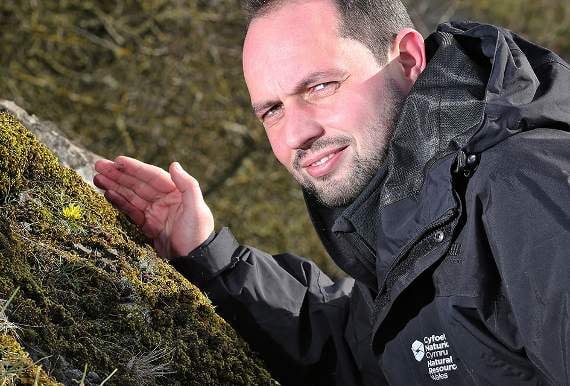
A RARE flower has come into bloom on a single hillside in Radnorshire.
The Radnor Lily, also known as the Early Star of Bethlehem, blooms for only two or three weeks every year in the UK – usually towards the end of February.
Four of the wildflowers, which have only been recorded in Wales since 1978, can be seen at the Stanner Rocks Nature Reserve near Burlingjobb on an old quarry face.
But blink and you’ll miss it because the small member of the lily family only grows to three inches tall – about the size of a daisy or buttercup – and can be hard to spot to the untrained eye.



The lily has flowered in the area for around 12,000 years – since the last ice age.
It is thought that the flowers are attracted to the site due to the age and quality of the old rocks which are understood to have been abandoned with the quarry as they were too tough to remove.
Rhys Jenkins, who works at the site, assists people who travel from all over the UK to find the tiny rare flower which requires a guide to get to its secretive location.
“The site is really special because of the geology.
“These are some of the oldest rocks in Wales which were forced up through the church stretton fault”.
He said: “They (the rocks at the reserve) are incredibly hard wearing meaning that the soils produced are quite thin and prone to desiccation.
“This means only quite a specialised plant community can survive here.”
Also referred to as the Welsh Star of Bethlehem, the lily is native to southern Europe and the Mediterranean as well as areas of northern Africa and the Middle East.
The scientific Latin name for the tiny yellow lily, which only blooms in the UK in the depths of winter when the sun is shining, is Gagea Bohemica.
Mr Jenkins said that while they don’t get as many visitors as other reserves, they’ve had visitors of all ages and physical abilities, and from as far as the north of England coming to see the miniature plant.
He said: “It’s because of the botanical rarities here (Stanner Rocks), and in particular the Radnor Lily, it is very popular with plant enthusiasts or twitchers.
“We don’t get particularly high numbers of visitors compared to your usual honey pot reserves, but the people who do visit make great efforts to get here.
“Some of them drive from the north of England just to see the flower, take a picture and then go home.”
Mr Jenkins said there is estimated to be over 1,000 of the plants on the site, but that less than one percent of them flower.
He said it can take an expert eye to find the plants while they’re budding so they cover them with cages to stop animals like rabbits eating the flowers.
He said they manage the site by controlling competing brambles and trees as well as grazing the site with ponies and sheep.
Mr Jenkins warned: “While this National Nature Reserve is a paradise for those interested in rare and unusual plants, visitors should be extremely cautious and not visit the site unguided, as the ground here is slippery and uneven with steep drops.
“The site is also home to other rare plants that could easily be damaged – if you are interested in planning a visit please contact the centre.”
You can contact the centre to arrange a visit by calling 0300 0653000 or by emailing [email protected].
It is thought the Radnor Lily will only be in bloom for flower-lovers to enjoy for another few days.