

With peak lambing season approaching, it’s a good time to take a look at the large number of objects in the Brecknock Museum collection that are related to sheep farming.
“Sheep farming is a vital part of the local economy, and it’s very important that the Brecknock Museum collection reflects that,” said curatorial assistant Jacquie Morgan.
“Over the years we have received many items connected with sheep farming, and they all help record and tell the story of something that’s central to the history of Brecknock and to many people’s lives here today.”
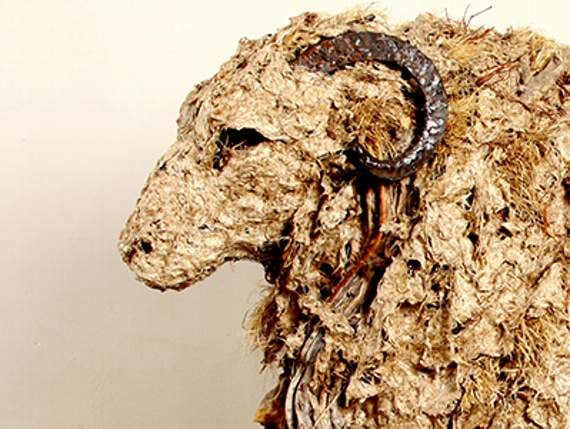
A prominent object in the collection is a sculpture of a sheep by renowned artist and sculptor Sally Matthews.

“This will be on display in y Gaer, and will be a very visible symbol of the importance of sheep in Brecknock,” continued Jacquie.
“Sally uses natural materials, which helps give her animals a realistic feel. She learnt about the bone and muscle structure of various animals by studying her father’s veterinary anatomy books, and by studying dead animals in the flesh, so her sculptures capture the spirit and essential characteristics of the animal.”
Many other objects in the collection help tell the story of sheep farming.
“As well as wool and meat, by-products from sheep were useful everyday items. An apple corer made from the leg bone of a sheep is an example of a handmade local object that would once have been common. It was given to the Brecknock Museum by an old farming family in the early years of the 20th century,” Jacquie explained.
Toys, in the form of small metal farmyard animals including sheep, are a reminder that many children were brought up with agriculture at the heart of their life.
Objects such as ear tags and tools such as a sheep castrator (the one in the collection dates from just after World War Two) illustrate how various sheep husbandry tasks were carried out. Decorative objects show how rural life was celebrated, such as ceramics with sheep depicted on them.
Photographs – including many from the John Jones bequest collection and from the Clarke Collection so generously gifted to the Brecknock Museum by the families – record sheep in everyday life, from being herded through villages to children playing with animals.
“Objects and images such as these help keep alive the memory of past lifestyles and employment, while also showing the thread of continuity through to farming families today,” added senior curator Nigel Blackamore.
The new y Gaer galleries will tell many stories about local lifestyles and livelihoods, with sheep farming being a very important part of that,” Nigel concluded. “If any readers have objects, photographs, paperwork, or stories connected with the history of sheep farming in Brecknock, that you’d like to share, we’d be delighted to hear from you. Remembering and celebrating local culture like this is an essential part of what we aim to do in y Gaer.”
You can contact Brecknock Museum on 01874 624121, or at [email protected].