

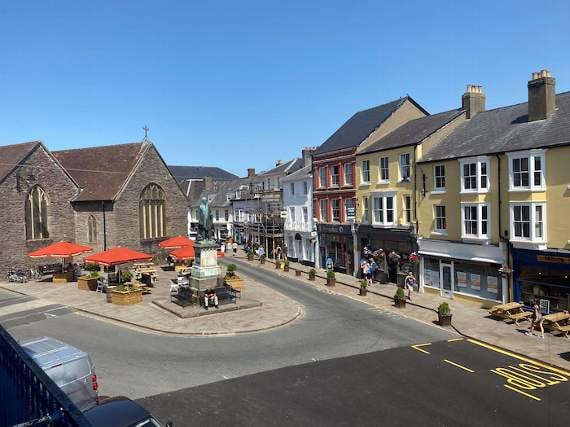

One in seven shops on high streets in Wales are empty and fewer ‘essential’ services such as post offices and banks remain in town centres, according to a new report.
These are among the findings of the newly released Regenerating Town Centres in Wales report, prepared by Audit Wales. Released alongside a second report, Professor Karel Williams ‘Small Towns, Big Issues’, the studies both conclude that town and city centres are at the heart of Welsh life, but addressing the challenges they face requires ‘imagination and ambitious leadership’, backed up by ‘co-ordinated, cross-government decision making’.
On the back of the reports’ findings, a Powys County Councillor has called on the Welsh Government to do more to help struggling town centres across the county.
Cllr Iain McIntosh, Conservative cabinet member for economic regeneration, runs a flooring business in Brecon and has been a businessman in the town for the past 27 years.


“Welsh town centres have been the heart of our communities for many decades, in some areas, centuries. In recent years the hearts of these communities have been eroded away to the point where there’s a significant threat to the cohesion of our communities across the country," said Cllr McIntosh.
“Many shops have locked their doors, put the shutters down and remain closed. Some have reopened as charity shops, or coffee shops, but the hustle and bustle we were used to many years ago, where shoppers would be bumping into friends, family and neighbours in our town centres, as they purchased food, clothes, electrical goods and furniture etc, is unfortunately a distant memory.
“Each town throughout Powys, and the rest of Wales, faces different challenges. Each town needs to take a different approach, but many of the answers are already there. Business organisations such as Chambers of Trade, together with individual business owners and entrepreneurs, already recognise the problems they face. They know how to deal with them too, but their calls for help have not been heard in town halls in some parts of Wales.”
Specific recommendations for both Welsh Government and for local authorities include everything from access to public transport and effective promotion of town centres to the simplification of funding streams.
“Both reports make clear that we have all failed to control out of town development and we need to mobilise alliances for change in our town centres to turn things round,” said Deputy Minister for Climate Change, Lee Waters.
“We need joined-up intervention to lift town centres, and an effort to tackle out-of-town development, if we are to succeed in turning things around.
“Today, I am pleased to confirm that our Ministerial Town Centre Action Group, which I will lead and will include our key stakeholders for town centre regeneration, will oversee the implementation of the recommendations made in both reports.”
The Deputy Minster also confirmed that the Welsh Government will make an additional £5m of loan funding available as part of the Transforming Towns project - added to the £60m in loan funding which has already been provided to support town centre regeneration.
But Cllr McIntosh believes this amount is not enough to deal with the nationwide problem.
“I approve of Welsh Government’s decision to establish a Ministerial Town Centre Action Group, with three sub groups, to tackle the findings of two reports mentioned in their press release, but I don’t think the addition of a £5million loan, labelled as funding, is anywhere near enough to start dealing with this problem throughout the whole of Wales,” he said.
“Welsh businesses and communities need to see a genuine commitment to dealing with this problem from Welsh Government and, as mentioned in the Audit Wales report, we need brave decisions and ambitious leadership.”
Cllr McIntosh also called on the Welsh Government to create a level playing field regarding business rate responsibilities between Welsh and English businesses.
“The Audit Wales report includes a reference to non-domestic business rates with a claim they make most town centres unattractive places to invest. I fully agree. For several years, business owners have never understood why Welsh businesses have had to pay higher rates than English businesses,” he said.
“The current business rates holiday has given a little breathing space, but once that ends, I must urge the Welsh Government to level the playing field by matching the business rates commitment Welsh businesses have to make, to those across the border in England.”
Comments
We've recently changed our login process. If you have an account for commenting, you will need to re-register on the login window.
This article has no comments yet. Be the first to leave a comment.