
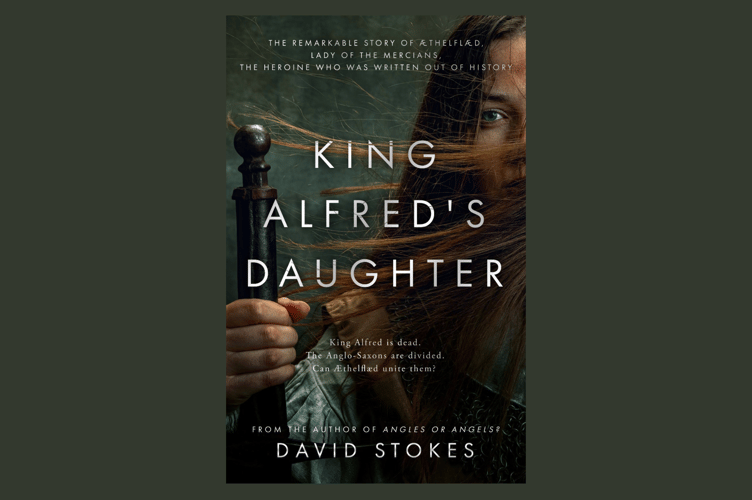
A new historical fiction novel with a connection to Llangorse Lake is set to be published next month.
King Alfred’s Daughter, by historian David Stokes, will be released on March 28.
King Alfred is dead and the achievements that made him great are in jeopardy. Rebels challenge the succession of his son Edward to the Wessex throne, and his old ally in Mercia is sick. The Vikings in the Danelaw sense the time has come to complete their conquest of England.
It falls on Alfred’s first-born, his daughter, Æthelflæd, to unite the Anglo-Saxons. Reluctantly, she takes up the challenge. But can she rebuild ruined towns and lead men into battle against hardened Viking warriors? Can Æthelflæd fulfil her father’s dream of a united England?



Based on contemporary sources and archaeological evidence, this story is rich in drama, family conflict and historical achievement.
David Stokes studied history at Oriel College, Oxford and is an Emeritus Professor at Kingston University. He has published widely in the non-fiction field during his career as an academic. The Anglo-Saxons have been a lifelong interest, and he has combined this passion with his research skills to write historical fiction focussing on the early medieval period.
David said: “Æthelflæd did not just have to deal with the Vikings . She also had problems with her British neighbours to the west in Wales. When Hwgan, king of Brycheiniog in the Brecon Beacons murdered one of her abbots, she led an expedition to his stronghold on Llangorse Lake, close to Hay-on-Wye.”
“Historians today acknowledge that Æthelflæd, the heroine of my historical novel ‘King Alfred’s Daughter’, was one of the most influential leaders of the Anglo-Saxon era,” David continuted. “Yet she was almost written out of the contemporary historical records by those anxious to promote their own power and legacy.
“Manipulating the media is all too familiar to us today; in Anglo-Saxon times it was even easier to control communication channels as the written word was confined to monk-scribes subservient to powerful kings.
“Fortunately, we can now piece together Æthelflæd’s achievements because local people recorded the impact she made in specific places. As ‘Lady of the Mercians’, she built well-known towns, such as Gloucester, Worcester, Shrewsbury, Tamworth, Chester, Runcorn, Derby, Bridgnorth and Warwick – places that today stand as monuments to her counterattack on the Vikings. By fortifying towns, founding churches as centres of learning, and inspiring her warriors, she helped fulfil her father’s dream of a united England.”
Comments
We've recently changed our login process. If you have an account for commenting, you will need to re-register on the login window.
This article has no comments yet. Be the first to leave a comment.