

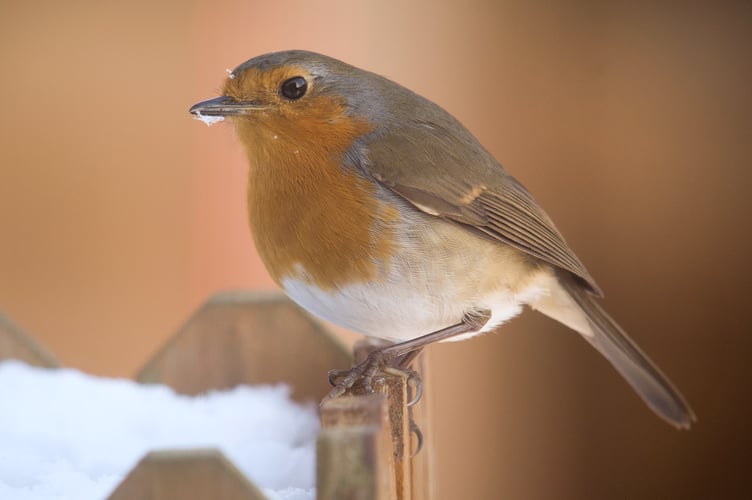
Farmers and land managers across Wales are being encouraged to take part in next year’s Big Farmland Bird Count, which returns from February 6 to 22, 2026, with a new digital system designed to make recording sightings easier than ever.
The annual count, run by the Game & Wildlife Conservation Trust (GWCT) with support from the NFU, provides a snapshot of winter bird populations on farmland and has become one of the most important citizen science projects tracking the health of the countryside. Next year’s launch will take place at the Allerton Project in Leicestershire, the demonstration farm where the idea for the count was first developed.
Since its first outing in 2014, the Big Farmland Bird Count has built up a decade of data showing how bird populations are responding to changes in land management. With farmland birds having declined by 63 per cent since 1970, the information gathered each February has helped identify which species are under the greatest pressure and what practical steps can make a difference on working farms.
The principle of the count is simple. Participants spend 30 minutes at a single location on their farm, shoot or holding, recording all the birds they see. The results are then submitted to the GWCT, helping to build a national picture of how farmland birds are faring during the toughest months of the year.
For 2026, results will be logged through the new PerdixPro Big Farmland Bird Count app, allowing sightings to be recorded in real time on a mobile phone or tablet, or uploaded later from home. Paper recording sheets will still be available for those who prefer them.
Joe Stanley, GWCT’s head of sustainable farming at the Allerton Project, said the count was as much about showcasing good farming practice as it was about gathering data.
“It’s fantastic to launch 2026’s BFBC from its birthplace here at the Allerton Project, where for more than three decades we’ve been demonstrating how food production and a thriving natural environment can go hand-in-hand,” he said.
“It took a mere three years to increase our songbird numbers by 75 per cent showing what is possible on a working, commercial farm.
“The BFBC is a great way for farmers and land managers to get out in the field and demonstrate the great work they’re doing to help nature thrive.”
Results from the 2025 count underline both the scale of the challenge and the impact of positive action. Nearly 359,000 birds were recorded during 1,332 surveys, covering 125 species. Of those, 26 were red-listed, including starling, lapwing and linnet. Encouragingly, sightings of common gull and kestrel increased sharply, while declines were recorded in species such as fieldfare and curlew.
Almost two-thirds of participating farms were in agri-environment schemes, with many providing supplementary winter feeding, measures which GWCT research shows can significantly boost bird numbers when combined with hedgerow management and habitat provision.
Full details, including bird identification guides and how to register, are available at: www.bfbc.org.uk
Comments
This article has no comments yet. Be the first to leave a comment.