

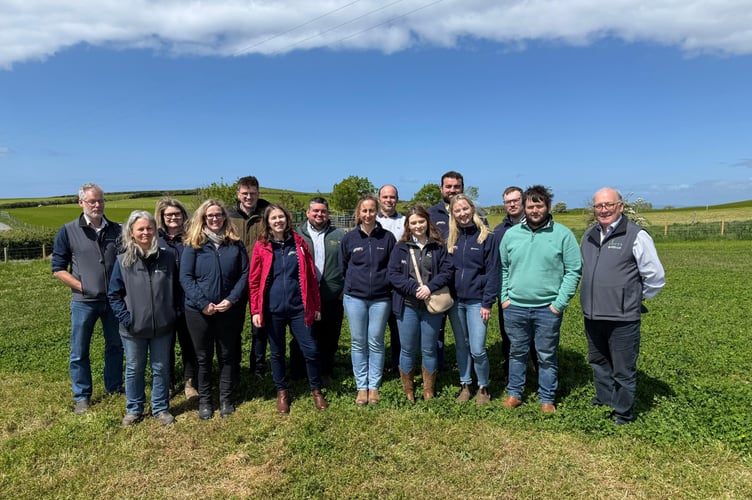
Members of NFU Cymru’s Next Generation Development Group have been given an insight into the innovation and research taking place in Wales that could benefit farmers in the future.
The cohort recently visited Aberystwyth University’s Institute of Biological, Environmental and Rural Sciences (IBERS) to learn how the department works with farming groups, policymakers and the supply chain to address the challenges facing the agricultural industry, with a strong focus on applied research and collaborative solutions.
Professor Alison Kingston-Smith, Director of Research at IBERS, provided an overview of the institute’s work, particularly its focus on using the genetic diversity of crops to increase resilience and sustainability in the sector. This research helped create IBERS’ high-sugar ryegrasses in the 1980s and, more recently, the breeding of new winter oat varieties that now make up more than 90 per cent of the UK market.
The group was then taken on a tour of the National Plant Phenomics Centre, where Dr Fiona Corke demonstrated how the centre uses automated growing and analysis to investigate how plant genetics are influenced by environment and treatment. This work has helped identify genes linked to drought tolerance, higher yields and stronger root structures, improving resistance to flooding and high winds.

Dr Hannah Vallin outlined how DNA metabarcoding is being used to identify the best species and traits for grazing, with the potential to develop forage crops that improve livestock diets, reduce methane output and allow animals to retain more energy from less feed. One highlight of the day for many was speaking to Jason Brook, the centre’s lead on drone technology and designated pilot, responsible for operating new research drone systems.
After crossing the road to AberInnovation, the university’s research and development facility, Dr Hugh Bulson led a tour of the biorefining and biomass conversion centre. Researchers there are developing processes to turn biomass and waste into products including pharmaceutical compounds, prebiotics and sweeteners. The group also heard about the work of the Future Food Centre.
NFU Cymru members then visited Dr Marley and Dr Jones at IBERS’ new Ty Hen grassland platform, where clover varieties are being developed as a more sustainable protein source for livestock in a controlled, field-scale environment that includes grazing animals.
To end the day, Dr David Lloyd, from Germinal, took the Next Generation Development Group to Cae Gwastad, IBERs field plots used for testing the growth and breeding of these grasses, clovers and other legumes. Here, Dr Lloyd showed how Germinal scientists have successfully managed to increase the persistence and resilience of red and white clovers.
NFU Cymru Next Generation Group member Andrew Peebles said: “It’s great to see the world-leading research and development being carried out here in Wales by IBERS and to learn more about how it can be applied on farm. As the next generation of farmers, it’s vital that we embrace new innovations to improve productivity while building resilience to climate change, ensuring we can continue to produce food sustainably for the future.”
Comments
We've recently changed our login process. If you have an account for commenting, you will need to re-register on the login window.
This article has no comments yet. Be the first to leave a comment.