

Meadow Arts presents BorderLands: From the Welsh Borders to Antarctica: twenty-one contemporary artists explore territory, identity and belonging, an exhibition at Hay Castle in the Welsh border town of Hay on Wye, from 14 May to 31 August 2026. BorderLands is made possible thanks to a grant from the Colwinston Charitable Trust 30th Anniversary Fund.
At a time of renewed geopolitical tensions and increasing polarisation, when issues around identity, belonging and territory are amplified, borders are often the focus for socio-political and cultural disunity. Set within the thousand year old border fortress of Hay Castle, BorderLands attempts a more layered understanding of borders and explores their ambiguity.
The artists in BorderLands span a range of practices including painting, photography, film, sculpture, walking, drawing and textiles. Whilst some focus on the shifting borders and communities of the English/Welsh landscape, others draw on Africa, Antarctica, Spain, Morocco and Northern Ireland, and specific sites such as Hadrian’s Wall and the English Channel to explore socio-political issues, identity, environment, protest, migration and colonisation. Others redraw the world map, erasing borders and countries, or investigate historical, mythical and abstract spaces.
BorderLands is part of Meadow Arts’ three-year programme marking their 25th anniversary, which attempts to uncover a more nuanced understanding of borders. Specially commissioned artist Maya Rose Edwards has worked with communities in three border towns to reimagine the border as a living, evolving space through talking and walking, beating the bounds and collaborative map making. In 2027 Meadow Arts will present a new commission for the programme by artist David Blandy.
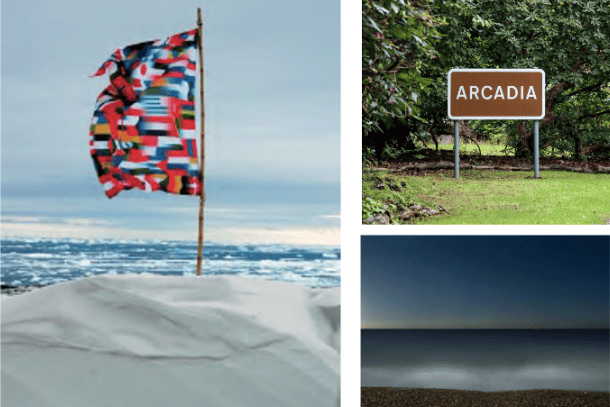
From the 12th century Gate Tower of Hay Castle flies a large flag from Lucy + Jorge Orta’s Antarctic Village No borders (2026), patterned with the flags of many nations. Beyond a medieval gate leading to the Castle’s terraced lawn is Arcadia (2007), Leo Fitzmaurice’s three traffic signs that playfully allude to the rural idyll of the scenic borderlands beyond.
Inside the Castle, on the ground floor of the Great Hall two of Lucy + Jorge Orta’s domed tents from Antarctica (2015), stitched with second-hand clothing, flags and gloves, hint at struggles for freedom of movement and safety. Above the fireplace Larry Achiampong’s new flag Siblinghood (2026) relates to attempts by the African Union to allow African citizens to travel visa-free across the continent. In front of the fireplace mimicking a protective fireback, Mark Houghton’s plate-bronze Plan (2019) contains the folds and creases of a world map but without the borders of countries. Maya Rose Edwards’ maps, documentary film and soundtrack, and her long sculptural hedge created with hedge layer Trefor Prothero suggest alternative ways to create borders without identified routes, rights of way or borderlines.
Nested within BorderLands on the Great Hall Mezzanine artists André Lichtenberg, Donovan Wylie, Charlie Hurcombe, and Henna Asikainen present works investigating the borders of the United Kingdom. Lichtenberg’s large-scale photograph Impossible Utopia (2016) taken following the Brexit referendum, depicts a seascape that stretches from a beach in southern England to the French coast. Wylie’s image from his Watchtower series of a lookout overlooking a rocky expanse weaves the presence of conflict and borders into daily life. From Wylie’s Lighthouse series a photograph taken on a key date in the Brexit timeline depicts the Irish Sea as a symbol of identity and insularity. Hurcombe’s meandering 7-metre, 22-piece Wanderlust (2024) made from an oak felled by a storm on the Welsh Borders, draws on ideas of separation and connection. In Future Pasts (2023), a performative protest filmed by drone, Asikainen explores nature, community and belonging in an act linking origin to destination along Hadrian’s Wall.
On the inside walls of the ruined tower in the Castle’s medieval keep, Hilary Jack’s new edition of her neon installation No Borders (2026) quotes aviator Amelia Earhart’s response to the world from above: NO BORDERS JUST HORIZONS ONLY FREEDOM, a proposal for landscapes without borders that resonates deeply with current conflicts.
In the main gallery space under the eaves of Hay Castle’s Jacobean manor house, Shilpa Gupta’s There Is No Border Here (2007) is a national flag made from high-visibility security tape in the form of a lyrical text expressing personal attempts to deal with control. Gabriella Hirst’s Skin I (2025) rendered in ornate wrought iron fencing, garden planters with plants, and steel security blades presents the domestic garden as a fiercely defended territory. Divided Landscapes (2025) Hélène Muheim’s Ending Frozen Line (2022), is a diptych drawing of a mountain range created from eye make-up powders and graphite that amplifies the geological power of landscapes as indivisible entities where humankind has little agency.
Corinne Silva’s large photographic image Imported Landscapes (2010), features photographs of Moroccan scenery installed on huge billboards in southern Spain, physically connecting the landscapes of two countries who have a history of exchange and conflict. Daniel McCarthy’s painting The Crossing, of a pair of feet edging along a log over water, explores the watery divisions that separate territories and the instability that borders engender. Drovers Lane (2025), Verity Howard’s abstract ceramic sculpture made from the earth of the Welsh borderlands is inspired by the old drovers’ routes around Offa’s Dyke that switched between England and Wales. Delaine Le Bas' photograph, No State Control (2025) draws on her familial Romany heritage, asking "Who puts who in the boxes and who labels the boxes? Who has the right to call who what?
Sally Payen’s painting Cross stitch through the Dirty Page of History remembers the women’s peace camp of Greenham Common in the 1980s, representing the mesh fencing with the repetitive, decisively gendered marks of cross stitch. In Lesson 56 (1997), Peter Finnemore’s photographic blend of history and myth centres on the pages of a history book that his Welsh grandmother used as a schoolgirl, portraying her country as seen from the English side of the border. Iwan Bala’s three works, Castles Everywhere / Cestyll Bobman (2014-2025), Colony / Cambromundo (2010-2015), and On the Borderlands / Ar y ffin-diroedd (2026, created for the exhibition) are vigorous ‘fieldnotes’ contemplating the place of Wales in culture, society and history.
Artistic Director of Meadow Arts, Anne de Charmant said,”In this troubled period of global uncertainty and socio-political tensions, Meadow Arts wanted a more layered understanding of borders through the contribution of twenty-one artists. Our location in the rural region known as the Welsh Border creates a fertile environment for exploring new perspectives and envisaging new connections, with Hay Castle the perfect host for such a project.”
Tom True, Executive Director of Hay Castle said, “Hay Castle sits on the Welsh border itself, so it feels like a particularly fitting place to explore ideas of borders, belonging and landscape. BorderLands brings contemporary art into dialogue with the castle’s 900 year history and the landscape that surrounds it. It reflects our ambition for the castle to be a place where history, contemporary art and new ideas meet.”
Mathew Prichard CBE, Chair of The Colwinston Trust said, “The Colwinston Trust is delighted to celebrate 30 years of working with many high-quality arts organisations across the UK by awarding a special Anniversary Grant to support exhibitions at Hay Castle, including the inaugural exhibition BorderLands, and the forthcoming exhibition Within by Rebecca Louise Law in an ambitious new contemporary arts offer for Mid Wales.”
Comments
This article has no comments yet. Be the first to leave a comment.