
FURTHER details on which children can attend at schools next week have been confirmed by the Welsh Government.
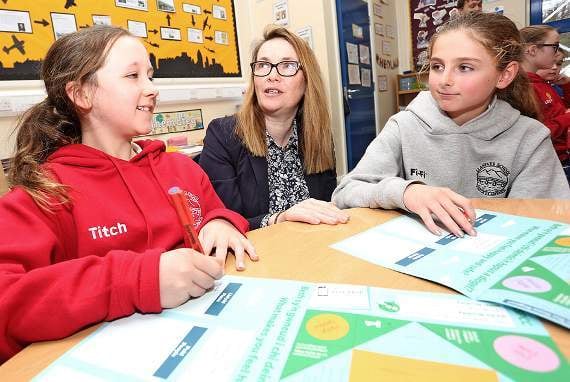
But Kirsty Williams, the Welsh education minister, has said as many children as possible that can stay home, following the closure of schools today, should do so and they should follow the same advice to avoid social contact as adults.
Key workers, including health staff and those in the emergency services, are like all other parents, being asked to make arrangements for their children to be cared for at home. If If there is no safe alternative, they should be able to attend schools or other settings.
In a statement, with the deputy minister for health and social care Julie Morgan, Ms Williams said: "The most recent scientific advice on how to further limit the spread of COVID-19 is clear. It is imperative that, as far as possible, we minimise social contact. This means if children can stay safely in their home, they should, to limit the chance of the virus spreading.


"Childcare and play settings, schools, colleges and other educational establishments are safe places for children. However, to reduce mixing between different groups or settings we need to minimise the number of children making the journey to school or a childcare setting, and keep to the minimum possible the number of children in educational or childcare and play settings.
"The smaller the numbers, the more we can lower the risk that the virus can spread and infect vulnerable people across our communities.
"Quite simply the fewer people having social contact, the more effective the overall impact of the current measures will be.
"This means parents need to keep their children at home, wherever possible and schools and childcare and play settings should be open only for those children who absolutely need to attend."
The statement said residential special schools and boarding schools and special settings should continue to care for children where possible.
The government has also said it will provide for all pupils entitled to free school meals and further details will be announced.
Childcare and child-minding services, including nurseries and creches, are also being told to limit access to the children of critical workers or vulnerable children and work with local authorities to do so.
Key points about schooling/childcare from Monday, March 23
• If it is at all possible for children to be at home, they should be
• If a child needs specialist support, is vulnerable or has a parent who is critical to the Covid-19 response, then provision in an educational or childcare setting should be available for them
• Parents should not rely anyone who has been advised to be following social distancing guidance, such as grandparents, friends, or family members with underlying conditions, for childcare
• Parents should do everything they can to ensure children are not mixing socially in ways, which could contribute to spreading coronavirus. Children should observe the same social distancing guidance as adults
• Residential special schools and special settings should continue to care for children wherever possible
These are the critical sectors announced by the Welsh Government
Health and social care this includes but is not limited to doctors, nurses, midwives, paramedics, social workers, care workers, and other frontline health and social care staff including volunteers; the support and specialist staff required to maintain the UK’s health and social care sector; those working as part of the health and social care supply chain, including producers and distributers of medicines and medical and personal protective equipment.
Education and childcare this includes nursery and teaching staff, social workers and those specialist education professionals who must remain active during the Covid-19 response to deliver this approach.
Key public services this includes those essential to the running of the justice system, religious staff, charities and workers delivering key frontline services, those responsible for the management of the deceased, and journalists and broadcasters who are providing public service broadcasting.
Local and national government this only includes those administrative occupations essential to the effective delivery of the Covid-19 response or delivering essential public services such as the payment of benefits, including in government agencies and arms length bodies.
Food and other necessary goods this includes those involved in food production, processing, distribution, sale and delivery as well as those essential to the provision of other key goods (for example hygienic and veterinary medicines).
Public safety and national security this includes police and support staff, Ministry of Defence civilians, contractor and armed forces personnel (those critical to the delivery of key defence and national security outputs and essential to the response to the Covid-19 pandemic), fire and rescue service employees (including support staff), National Crime Agency staff, those maintaining border security, prison and probation staff and other national security roles, including those overseas.
Transport this includes those who will keep the air, water, road and rail passenger and freight transport modes operating during the Covid-19 response, including those working on transport systems through which supply chains pass.
Utilities, communication and financial services this includes staff needed for essential financial services provision (including but not limited to workers in banks, building societies and financial market infrastructure), the oil, gas, electricity and water sectors (including sewerage), information technology and data infrastructure sector and primary industry supplies to continue during the Covid-19 response, as well as key staff working in the civil nuclear, chemicals, telecommunications (including but not limited to network operations, field engineering, call centre staff, IT and data infrastructure, 999 and 111 critical services), postal services and delivery, payments providers and waste disposal sectors.
If workers think they fall within the critical categories above they should confirm their specific role is necessary for the continuation of this essential public serviceFurther information can be found at https://gov.wales/education-coronavirus