

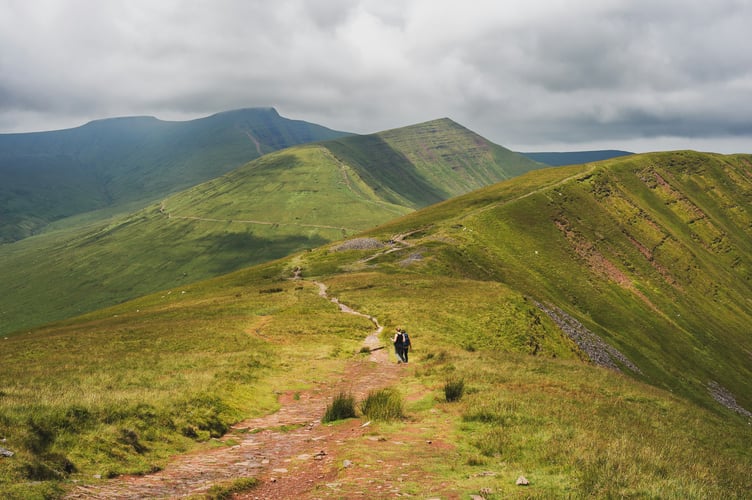
A group will be set up to review Welsh place names in Bannau Brycheiniog National Park and decide on their official spelling.
At a meeting of the National Park Authority (NPA) on Friday, February 6, members received a report outlining how Bannau Brycheiniog intends to promote the Welsh language over the next five years.
Head of Communication Bronwyn Lally said: “The strategy outlines several measures the authority intends to take over the next five years to promote the use of the Welsh language, building on the success of our rebrand in 2023 and the reclaiming of our Welsh name, Bannau Brycheiniog.
“We’re now proposing to phase in a Welsh place-names-first approach, with the Welsh names to be used in all of our literature, social media, signage, etc.”


Another move would be to have simultaneous Welsh language translation at authority meetings, explained Ms Lally.
Authority Vice-Chairwoman Dr Liz Bickerton said: “I do welcome this; there are a lot of place-name features in the park that are known by other names. For our heritage and culture, we need to make sure we use the proper names for these places because they are tied up so much with our history.”
Board member Julian Stedman said: “Some of our place names in the Welsh language seem to be spelt differently in different translations.
“Trellech (in Monmouthshire) is spelt in three different ways on different signboards, which is very confusing, I guess, if you’re filling in forms.”
He added that this issue was also prevalent for the town of Crickhowell in Powys, with several different spellings of the name in Welsh. These versions include Crucywel and Crughywel.
Mr Stedman asked: “How are we going to find a definitive way so that people don’t start arguing with us over spellings, which is a bit trivial but a real issue for those that live in places where the name is not clear?”
Ms Lally answered: “We will be drawing up a definitive list of what we will be using as an authority for these places with different spellings, and we will look to work with organisations to make sure we are using the correct one at every point.”
Board member Canon Aled Edwards said: “I very much welcome the statements being made. I think the Welsh place-name issue is very significant in terms of safety in the park.”
As a first-language Welsh speaker, Rev Edwards explained that a knowledge of Welsh place names is “extremely useful” and provides practical information about sites.
Canon Edwards said: “The most obvious example of all is if you go up Pen-y-Fan, knowing Bwlch Du Wynt is handy.
“Because it tells you there’s a dark wind up there. The hint is in the name on whether it’s safe to go there on snowy, wet, or misty days.
“There are advantages to knowing a bit of Welsh. On the whole, barring very few exceptions, the Welsh standard spelling is very much a settled issue.”
He went on to explain that some issues are down to the corruption of Welsh place names by the English language, which means that local pronunciation is “very different” from how a Welsh speaker would say them.
“All the issues around spelling standardisation are within the gift of human beings to resolve,” said Rev Edwards.
The authority unanimously agreed to the strategy.
Comments
This article has no comments yet. Be the first to leave a comment.