
Powys County Council has given its first detailed explanation behind its decision not to allow a debate of the proposed changes to the Local Development Plan which could pave the way for more solar and wind farm developments in the county.
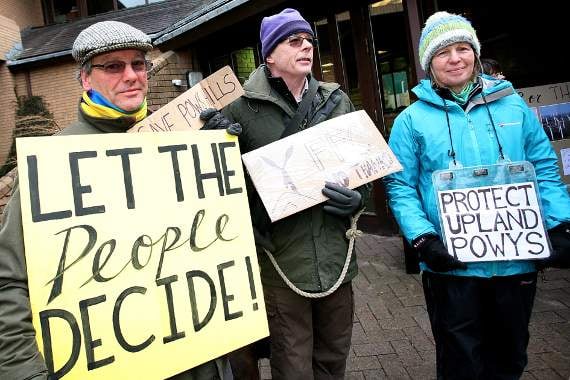
That decision prompted about 100 demonstrators to gather outside the council’s offices in Llandrindod Wells before last week’s meeting which set the council's budget for the coming year.
The council has put out a statement saying that three notice of motions about the Local Development Plan were rejected as they did not comply with the council’s constitution.
The statement says that the first two motions for the meeting on February 23 were refused as they were judged to be a "call in" of a decision of the cabinet.



The council has pointed out that it has a clear procedure which only allows cabinet decisions to be called in by the chair of scrutiny or five members of the scrutiny committee.
The statement adds that its constitution clearly points out that members cannot use a motion to county council as a method of calling in a cabinet decision and hence the debate by full council was not allowed.
A third motion for full council for March 7 was rejected on the grounds that it did not comply with the council’s constitution as it was not received within the timescale set out within the constitution.
Cllr Wynne Jones, deputy leader and cabinet member for democratic services, said: "The fact is that the notice of motions did not comply with council’s constitution and that is the reason they were either refused or rejected.
"The constitution is approved by members of the County Council and they should be fully aware of the rules and procedures when submitting a notice of motion. It is a failure to follow these procedures that led to the notice of motion being rejected."
In response to the statement, Peter Seaman who chairs the Brecon and Radnor branch of the Campaign for the Protection of Rural Wales, said: "The cabinet and the council’s legal team are fully aware that many county councillors are unhappy about this issue and were desperately seeking a manner of debating it.
"Rather than finding legalistic reasons to suffocate debate, they should have been cooperating with their councillors to provide a forum for debate. The relationship of the inner circle to elected county councillors is one of manipulative tight control of both procedure and information which stifles democracy.
"In short we have a local government whose main concern is to cover up for their inability to involve electors and elected councillors in their policy making and to care for the unique Powys countryside for future generations."
Jenny Keal, of the recently formed Brecon and Radnor Action Group, said: "This is just one more illustration of the cabinet’s determination to restrict the rights of councillors and the public to have their say in a huge land grab policy with enormously damaging implications for the county and its residents. "We have been excluded from any voice in shaping this policy because at this stage of the LDP process we are only allowed to comment on ‘soundness’ of the policy, and not on whether it is appropriate at all for the county."Although the cabinet approved the LDP Further Focussed Changes at their cabinet meeting on September 13 2016, councillors outside the cabinet knew so little about these changes that a seminar was arranged for them on November 10, only shortly before the conclusion of the public consultation period and giving them no time to consult their constituents."The public have good reason to doubt that they were even intended to be aware of this policy at all."The failure of the officers of Powys council to make sure that they are seen to be acting in a fair and democratic way and their lack of concern about the criticism they are receiving can only lead people to conclude that they have no respect for their councillors or their constituents. With the elections in May they may come to regret their secrecy and subterfuge."
The council says it is continuing to undertake further work on the renewable energy assessment before it is submitted to the Planning Inspector, who will conduct the independent examination to assess the soundness of the council’s Local Development Plan.
The further work on the assessment and supporting evidence for the proposed local search areas is being undertaken in response to the representations made on the Further Focussed Changes to the LDP.
Although the additional work has not been completed, it is likely that the council will be recommending changes to the Local Development Plan in relation to the extent of local search areas to the Planning Inspector through the examination’s hearing sessions.
Cllr Tony Thomas, cabinet member for regeneration and planning, said: "The Local Development Plan is the most important planning document we have and we are determined to ensure we have a robust framework in place. It is a policy for the long-term and it is important that we get it right for the future.
"As part of this process, we are working hard to ensure that the renewable energy assessment is a robust document before we submit it to the Planning Inspectorate as part of the Local Development Plan examination.
"At the end of the Local Development Plan examination process, the final document will be presented to all elected members at a County Council meeting of the council for them to determine whether to adopt the plan or not."