
A COUNCILLOR said he fears Brexit could impact on Powys council’s ability to fund new primary schools.
The authority is in line for millions of pounds of funding under the Welsh Government’s 21 century schools programme to build new primaries in the Hay-on-Wye and Talgarth areas.
A condition of the programme is the authority must find match funding towards the project - which Powys council intends to do through borrowing.
But Talgarth councillor William Powell said he fears a financial hit from Britain’s withdrawal from the European Union could hamper the council’s ability to find the required funding.


The Liberal Democrat said: "The concerns I have relate to things like the local authority’s investments. If the stock markets take a hit in the long term hit, as some are forecasting, there could be a significant hole in the finances of the council and other local authorities and lead to a strain on budgets.
"I think that’s particularly important in relation to the 21 century schools programme. It would be a catastrophe if there was a risk due to the availability of match funding."
The councillor, who had campaigned for Britain to remain in the EU and served as a Welsh Assembly Member for Mid and West Wales until this May, said he planned to raise the issue at the council’s audit committee this week.
He said he was also concerned at any impact on the council’s pension funds.
Cllr Wynne Jones, who has responsibility for finance, updated the council’s cabinet on how Brexit could affect the council when it met on Tuesday.
A report by Cllr Jones said as yet it too soon to say what the impact of Brexit would be.
The council has a section that supports applications for EU grants which he described as "very successful in obtaining funds."
He warned: "The work of the team will be affected by Brexit and over the medium term this will effectively cease to be focussed on EU issues but until the UK’s relationship is defined via the negotiations the precise position cannot be indicated."
Powys currently receives EU funding worth £1.48m over the next three years, which supports a project at Llandrindod Lake and work by the council’s youth services.
An email, sent by council chief executive Jeremy Patterson, to all council staff said: "Powys currently receives in the region of £80m in farming subsidy from Europe under the Common Agricultural Policy and some of our staff are directly involved in work related to the administration and distribution of European Funding.
"I would like to reassure all colleagues that while there is a degree of uncertainty on a range of matters that affect both council staff and our communities, there will be plenty of time to work through the detail of the change and make sound judgements on the future as more information becomes available.
"The cabinet, management team and myself will be working closely with the Welsh Government and Welsh Local Government Association to determine how the UK’s exit from the EU will affect Powys in the longer term, and I will update you as this becomes clearer. "
Mr Patterson said he was confident the council could "successfully meet the challenges of leaving the EU in the interests our communities".
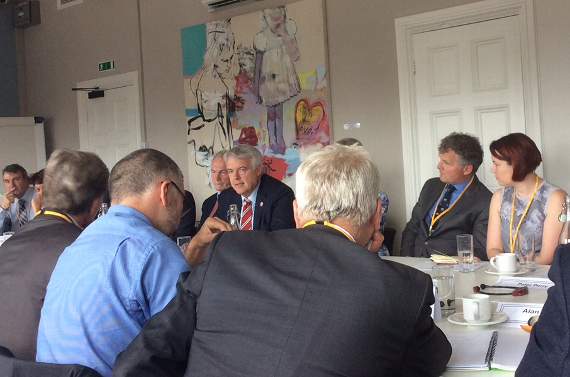
Meanwhile Wales’ First Minister has held discussions on the impact of Brexit with key figures from the agricultural industry.
Carwyn Jones hosted the round-table discussion in Cardiff with his environment and rural affairs secretary Lesley Griffiths.
Farming union leaders, rural business-people and representatives of environmental bodies attended the meeting on Monday.
Ms Griffiths said: "The First Minister and I attended a very constructive round-table discussion with key representatives of Wales’ environment and rural affairs sectors. It was a crucial opportunity for the First Minister and I to take on board the thoughts and concerns of the farming and fishing communities, rural businesses and environmental bodies on what the UK’s withdrawal from the EU means for them.
"Issues raised at the meeting included the future of vital funding sources, access to the single market and how together we can explore opportunities to develop distinctly Welsh policies. It was also an opportunity for us to confirm that important rules on environmental issues such as carbon emissions and air quality, instigated by the EU, continue to be adhered to.
"The First Minister is negotiating with the UK Government over the terms and timing of Britain’s exit from the EU and he assured attendees that the issues raised will be at the forefront of his mind during these negotiations.
"This was just the first of a series of meetings I will be having with members of Wales’ environment and rural affairs sectors. I will be visiting farms and rural businesses over the coming weeks to hear directly from them what they think about UK’s exit from the EU – the challenges posed but also the potential opportunities presented. I am looking forward to discussing how the Welsh Government can work closely with them to ensure Wales’ rural affairs industry prospers in the years ahead and continues to make a hugely important contribution to Wales’ economic well-being."
Speaking after the meeting, Stephen James, NFU Cymru president, said: "We thank the First Minister and Cabinet Secretary for meeting with us to discuss our vision for the future of Welsh agriculture post-Brexit.
"While we are currently in a period of uncertainty, the EU Referendum result presents us with a great opportunity to reshape trade and environmental policies and develop an overall Welsh agricultural policy that is fit for purpose, forward thinking and enables us to develop, grow and realise NFU Cymru’s ambition for a productive, progressive and profitable industry that will result in jobs, growth and investment for Wales.
"There is no question that there is a lot of work to do and there are some important decisions to be made, but I firmly believe that at NFU Cymru we are ideally placed to work with Welsh Government and lead the way to a framework that works to the benefit of Welsh farmers and Welsh communities."