
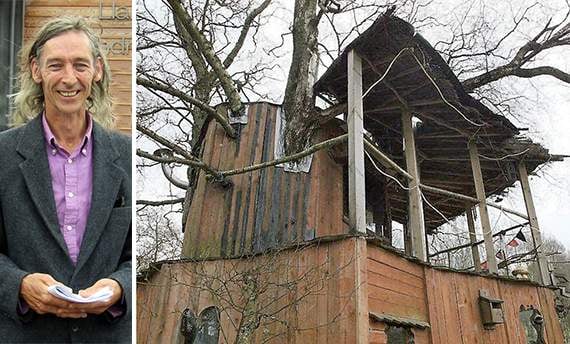
A SMALLHOLDER has told his Crown Court trial he believed he could reuse and keep structures for agricultural use despite losing a planning appeal.
Eddie McIntosh is accused of failing to comply with planning enforcement notices issued against him by Powys County Council and which were mostly upheld when he appealed against them.
The 52-year-old said he accepted he could no longer use his smallholding, Mellowcroft, alongside he main A44 road at Llandegley, near Llandrindod Wells, as his permanent residence and a rural retreat and holiday accommodation after losing the appeal in January 2016.
But he said he understood the planning inspector’s decision that the land be restored back to agricultural use meant he could keep many of the structures.



Under cross examination from prosecutor Christian Jowett, on the fourth day of the trial at Merthyr Crown Court, he said it would have been "unreasonable and excessive" for him to have to have removed all of the structures.
Mr Jowett said there was no qualification in the notices that structures that he had been ordered to remove could remain if they were used for another purpose.
The defendant replied: "The enforcement notices say I can’t use the land for recreational use and to restore the land to agricultural use."
He said he did begin work to dismantle a tree-house he and his wife and young daughter lived in but said he kept other structures, including small pallets used as a footbridge, a compost toilet, and a small wind turbine as they could be used for agriculture.
Asked whether he had moved a footbridge the defendant said it was unclear which footbridge should be removed as there were four on site and the notice was amended to say remove a single footbridge rather than footbridges.
But he said footbridges were essential for agricultural use and the planning inspector had allowed him to keep allotments which are used by the community.
He said: "It’s common sense to have footbridges, it’s health and safety. I can’t expect volunteers to jump across a ditch. It doesn’t make sense at all."
A compost toilet, which was approved for use by the council’s environmental health departments, was also necessary. He said: "Taking away a toilet is excessive. I have the probation service come and use the land and the Job Centre Plus. I can’t not have a toilet."
He also said the small wind turbine, the size of a "Land Rover wheel", is essential for farming as it used to power an electric fence.
"If I was to remove the wind turbine I have two huge sows, the only was to keep them is with an electric fence if they were to escape on to the A44, it would be ridiculous."
The defendant said he had started taking down the tree house, though some of the planks still remain, as he accepted the planning inspector’s decision and he said he associated it with the retreat rather than an agricultural use.
But he said progress on dismantling it had been slow and complicated due to birds nesting in the now disused structure and a badger set on its lower levels.
Asked by Mr Jowett if he had taken advice on removing the badgers the defendant told him: "Well, they are a protected species it’s common sense but I did talk to local farmers."
He said he accepted the family could no longer live in the tree house once the planning inspector had given her decision in January 2016 but it had also taken time to remove the family’s personal belongings from it as well as disconnecting its solar powered electricity supply.
Challenged, by Mr Jowett, that he had refused to accept the outcome of the appeal and that he needed to comply with the enforcement notices the defendant replied: "You know that’s not true. I just put on a farmer’s hat and got into intelligent farming. Agriculture is not just sheep farming. I started well and built a shop trailer to sell agricultural produce alongside the A44."
Asked by His Honour Judge Christopher Vosper QC if he still lived at Mellowcroft, in a converted trailer on stilts, the defendant confirmed he did.
When the judge asked if he believed he could live there as the residence was temporary and agricultural the defendant said yes. He had previously confirmed to the court he had paid council tax to Powys council and kept it informed of his living arrangements.
The trial continues.