

Important conservation work is continuing on the Brecknock Museum and Art Gallery collection as preparations for the move to Y Gaer gather pace. Currently the art collection is being surveyed with three objects of particular interest receiving attention.
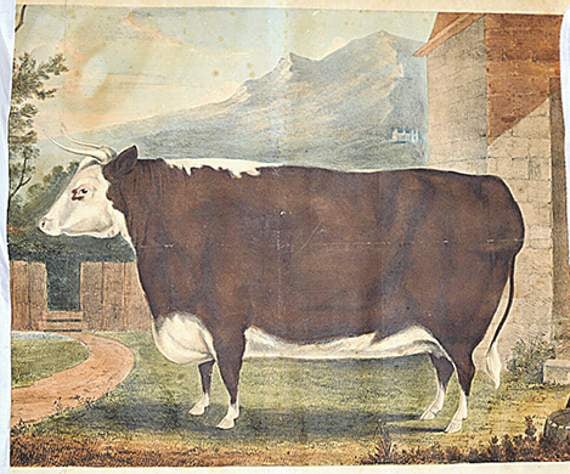
“There is a large watercolour of a ‘fat heifer’ owned by Joseph Bailey Esq of Glanusk,” explained accredited conservator Cath Lloyd Haslam. “The inscription adds that the animal was ‘slaughtered January 28, 1832 by Mr R Bright of Brecon’. It’s a fascinating piece of evidence about local farming. We removed the artwork from its frame, which was not original.
“The painting is suffering from woodburn, a type of discolouration caused by acidic materials such as backing boards. It also has marks from a fold and damaged corners. Having been assessed and after receiving initial treatment, this ‘fat heifer’ will now have further attention from a paper conservator.”
Cath and her colleague Anastasia Gkouma have removed acidic backings (such as plywood) from several paintings. “We replace this with an acid-free board, fixed with stainless steel pins,” explained Anastasia. “We have also been using thin polyethylene sheeting as a liner to protect the artwork.”

The second interesting object is a local dolls house. Conservator Aly Singh from Cardiff University’s Conservation Practice course has been working on this. “It dates from the late 18th/early 19th century with a few later additions. It came from Struet House in Brecon and was one of earliest donations to the Museum. The dolls house is a fascinating challenge from a conservation viewpoint because of the variety of materials involved – including real coal in the grate. The great thing about the Cardiff conservation course is that it teaches us the problem-solving skills to deal with complex items like this, containing many different component materials.”
Aly is also working on the third interesting object: a 19th century ornamental wooden rattle. She said: “This is an intricate piece including three chains carved from one solid piece of wood, in a similar style to traditional love spoons. It’s a stunning example of ‘treen’ or rural folk art.”
Removing encrusted polish from the rattle has been a painstaking task. “We use non-ionic detergent and water applied with cotton wool swabs,” said Aly.
“It’s a real privilege to contribute to the conservation of this fascinating collection. I’ve been involved in several projects here at Brecknock Museum and have built up strong connections with the museum and the town,” she added.
Over 300 objects have already been examined by the conservators. “These condition assessments help us prioritise and carry out immediate work, grade the objects, and plan ahead for future work so that all artefacts can be preserved for future generations,” explained Cath.
“We’re very grateful to the Federation of Museums and Art Galleries in Wales for providing funding from the Welsh Government for this project,” added senior curator Nigel Blackamore. “Their grant enables us to have conservation specialists working on our collection, thus enhancing our existing ongoing conservation programme as we look ahead to moving into Y Gaer.”
Brecknock Museum
Caitlin Gingell