
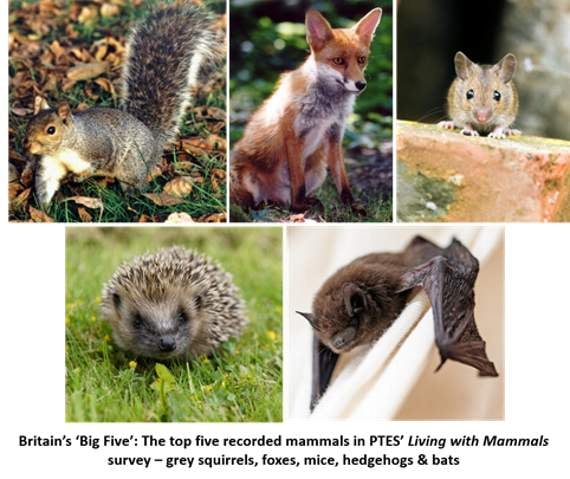
A charity is asking for volunteers to record all of the mammals they encounter this spring in a survey.
Last year the Living with Mammals survey by wildlife charity, People’s Trust for Endangered Species (PTES) recorded grey squirrels as the most sighted mammals in the UK followed by foxes, mice, hedgehogs and bats.
PTES is now asking members of the public to participate in this year’s survey by recording sightings of Britain’s ‘big five’ from last year as well as any other wild mammals they see using the urban environment and the green spaces within it.
The survey, which is to help aid future conservation efforts, will start on Monday (April 1) and last until Sunday, June 30 and volunteers can spend anywhere from ten minutes a week to several hours at their chosen location.



Those taking part in the survey can report mammals or signs of the mammals in any local green space – gardens, allotments, parks or green spaces near work.
The site chosen by volunteers, who can work together or individually, must be within 200 metres of a building and it can be in an urban, suburban or rural location.
David Wembridge, surveys officer at PTES said: “Green spaces, and the wildlife they support, are important—they provide food, clean air and water, and make us healthier and happier. Counting our wild neighbours, and knowing how their populations are changing, is a health-check on our towns and cities.
“As the weather warms up, we hope people will get out and see lots of wildlife - and the signs they leave behind, such as footprints or droppings.
“Long-term surveys such as Living with Mammals offer invaluable data to conservationists working to save Britain’s wildlife, with the help of the public. The results allow us to understand how populations of each species are changing – for better or worse. This lets us identify where conservation work is needed most.
“For example, surveys have shown that at least half of the hedgehog population has been lost from the countryside in the last two decades. As a result, we’ve been working really hard to help hedgehogs in the urban landscape and we’re now starting to see a more positive outlook. We hope this will encourage last year’s volunteers and others to take part this year and make a real difference for urban mammals.”
Animals which wildlife enthusiasts are more likely to see include rabbits, badgers and moles along with last year’s ‘big five’. Other species which live in the UK but are more difficult to spot include otters, red squirrels, pine martens, edible and hazel dormice, fallow deer, water voles, stoats and brown hares.
Mr Wembridge said: “Your chance of spotting particular species depends on where you are in the UK. Scotland, for example, is a stronghold for pine martens and red squirrels.”
Volunteers are asked to record their findings using the PTES website, which has more information on how to spot mammals and how to tell them apart, and photos of mammals can be shared with PTES via Twitter using the hashtag #LivingWithMammals.
The survey can also be completed via a printed pack – email [email protected] for more information.