
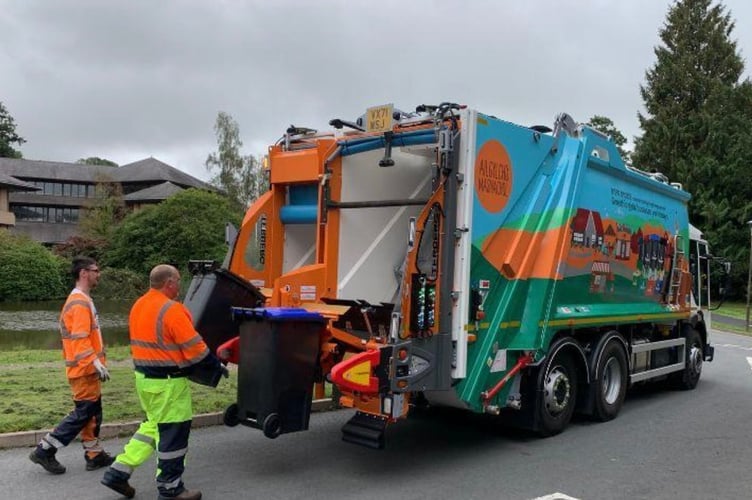
Council chiefs have admitted complacency over the roll-out of new recycling and refuse collection routes in March.
At a joint meeting of Powys County Council’s Governance and Audit Committee and the Economy, Residents and Communities (ERC) Scrutiny Committee on Wednesday, July 15, councillors and lay independent members forensically examined the reasons why the changes to collections had been so problematic.
This follows the shambolic roll-out of new collection routes from March, which saw rubbish and recycling left uncollected for days on end, causing anger among residents.
WRAP Cymru reviewed the changes and produced a report, which was before the joint committee.
It was revealed that the route optimisation was a bid to save the council £105,000.
A saving of £52,500 over two years had been included as a cost-saving proposal in the 2023/24 budget.
The joint meeting was chaired by Lynne Hamilton, chairwoman of the Governance and Audit Committee.
Mrs Hamilton asked: "Was there a formal project plan and governance arrangement to go with that or not?"
Head of Highways, Transport and Recycling John Forsey said there was a project group set up to manage the changes.
Mrs Hamilton asked if the project group worked to a clear brief and business plan to deliver the objectives.




Waste and Recycling Senior Manager Ashley Collins said: "We did a route optimisation back in 2018, which went far more smoothly with a lot less input than this time, so I think that made us a tad complacent in terms of how it would work.
"The project management process could have been much tighter. We had a couple of project officers working on this three or four years ago doing all the donkey work on it.
"There was a project team involving the area managers, myself, the data management officer and the communications officer, working weekly."
Ahead of the changes, all households in Powys received an information pack through the post outlining the changes and providing recycling tips.
Mr Collins said: "There was a long lead-in time for that. We had to get everything ready by the beginning of January.
"We did make the assumption that the vehicles would be ready by the end of February, and that didn't turn out to be the case. We had a few that weren't modified in time."
The electric vehicles also did not arrive in time, and Mr Collins explained that hiring similar vehicles at short notice proved difficult.
"There were assumptions made, as we had to get the publicity out and we wanted things to settle down before Easter," said Mr Collins.
Mrs Hamilton said: "It sounds to me as though the critical path was driven by the fact that the communication material had been ordered and a date set for its distribution."
Mr Forsey said that, for as long as he was in his role, there "will not be another route optimisation exercise".
"But we will be looking at things route by route to make sure things are balanced," said Mr Forsey.
The joint committee will come up with a number of recommendations so that the council can avoid similar project problems in the future.
Comments
We've recently changed our login process. If you have an account for commenting, you will need to re-register on the login window.
This article has no comments yet. Be the first to leave a comment.