
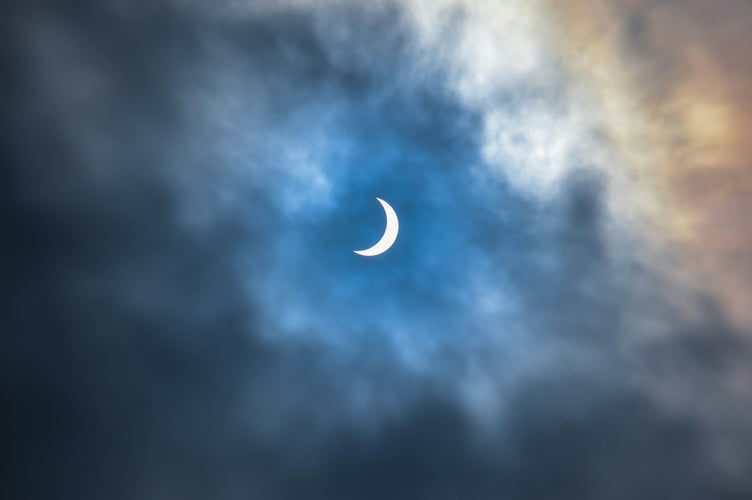
Stargazers across Mid Wales are being encouraged to look skywards next month as the region prepares for a rare double celestial event.
On Wednesday, August 12, a deep partial solar eclipse will be followed by the peak of the Perseid meteor shower, creating an unusual combination of astronomical events not seen for almost three decades.
A dual spectacle of this scale will not occur again for centuries.
The late-afternoon spectacle will begin at around 6:15pm BST as the Moon moves in front of the Sun. Mid Wales will experience one of the deepest eclipses in the UK, with around 94 per cent of the Sun obscured at the peak of the event at 7:12pm.
The eclipse will come to an end at around 8:06pm, before attention turns to the night sky and the Perseid meteor shower.
"All you need to enjoy this rare spectacle is a pair of solar eclipse glasses, and there is still time to buy a pair, which costs just under £5," said Sam Price, Dark Sky Officer for the Elan Valley International Dark Sky Park.
"Look out for public events that are running, as they will provide not just safety equipment to enjoy the view, but good company with like-minded people.
“Do not look at the sun with the unaided eye, even at maximum eclipse."
Solar eclipse glasses are needed to safely view the eclipse, while the Perseid meteor shower can be enjoyed without specialist equipment.
The meteor shower is expected to produce more than 100 shooting stars an hour under ideal conditions, as debris from Comet 109P/Swift-Tuttle burns up in the Earth’s atmosphere.




“For the Perseid meteor shower, all you need is your eyes and a location that is free from light pollution," Price said.
"It takes around 30 minutes for your eyes to become dark-adapted. A bonus object to look out for is the Milky Way, which looks spectacular in the stunning, dark skies of Mid Wales this time of year.
"Because the shower peaks during a New Moon, the absence of moonlight creates near-perfect dark-sky conditions.”
Comments
We've recently changed our login process. If you have an account for commenting, you will need to re-register on the login window.
This article has no comments yet. Be the first to leave a comment.