
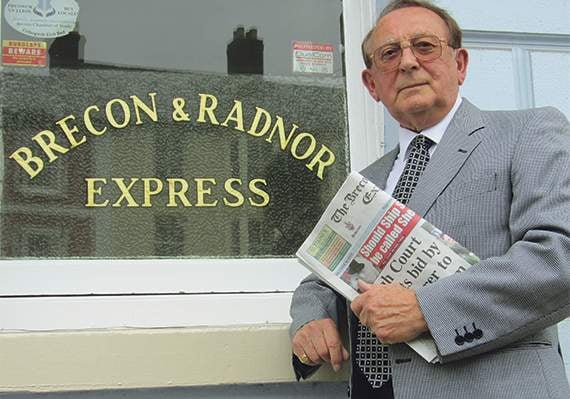
A FORMER Brecon & Radnor Express journalist was back at the paper recently – some 60 years after he first worked on it – to reminisce about his early days as a reporter.
Colonel Mike Peters was in Brecon after “being honoured” with the presidency of the Brecon Grammar School Old Boys Association. He started his career as a 17-year-old trainee at the B&R in the 1950s and after working on daily titles in England moved into PR and the military.
As a government press officer Mike was also responsible for running the Ministry of Defence newsdesk during the 1982 Falklands War and his career saw him cross paths with the likes of Michael Heseltine and Kate Adie.
“I wanted to go into the Royal Navy, my great uncle had been in the Battle of Jutland, but I couldn’t pass my maths exam,” said 77-year-old Mike, recalling the end of his school days at the Boys Grammar School.
“I had attempted to pass the maths exam in November when I got a call from the headmaster and he said ‘you’ve got English literature and language, would you like to work at a newspaper?’ I said I don’t know but I then came to meet the editor John F Morgan.”
That was in late 1956 and Mike, who’d grown up in Llanfaes, Brecon, was soon filing copy as varied as doing the film reviews and a fishing column, the latter due to his father’s fine reputation as an angler.
As a trainee Mike would also have to nip between the paper’s offices in the Bulwark, which are still occupied by the title today, and the former print works in Dan y Gaer Road and collect copy, filed by the Builth Wells-based reporter, from the train when it pulled into Brecon Station at nearby Camden Road.
When Mike, who now lives in Surrey, called into the paper’s offices he was keen to look back through the archives at some of the editions he helped produce and immediately spotted some familiar faces, including a picture of motorcycle racer Gwyn Chambers.
“I used to go to the High Sheriff’s lunches and report the speeches and we used to get lots of stories from the Army. I used to report on Christ College’s matches every Wednesday and in 1955 the Boys Grammar School had a new headmaster and had just started playing rugby. The school up until then, and indeed Brecon, had been all football. For many years the Corries were all-powerful and ran everything including the dances and used to sell tickets saying ‘Swing and Sway the Brecon Way’.”
Mike joined the Young Conservatives in Brecon “because like the YFC that’s where the girls were” but said “unusually” the paper’s editor was a Liberal.
However in the 1950s there was little politics in the paper’s pages: “We would never publish anything political at all, it would have to be a letter to the editor from, say, the Conservative candidate.
“We used to cover what Tudor Watkins, the Labour MP, was up to in Parliament. He would ask about phone boxes or bus stops. He was a very nice man.”
After three years Mike moved on as the paper was looking to downsize its reporting staff and he was ready for a new challenge.
“I went for an interview and the editor sat me down and said ‘do you play rugby’ I said yes and he said ‘when can you start?’. My first job was playing on the wing and at half-time and full time I had to phone in my match report. I went to the Express and Echo in Exeter and they had 60 linotype machines in their print works where in Brecon we had six.
“That was also where I first ran into trouble with the trade unions. I helped an old man who was pushing a trolley and everyone stopped. Someone said, ‘You mustn’t touch that, young man’. I said, ‘I was only trying to help the old man’.”
Mike still hadn’t given up on his military ambitions but was told he couldn’t join the Territorial Army as he was needed to work on Saturdays.
But a scoop about an underground nuclear bunker led to Mike being invited to join the volunteer Royal Observer Corps and when he moved from journalism to corporate communications he took his chance to volunteer for the Reserve forces.
During his time volunteering with the TAs, including the Military Police, and also with the cadet forces Mike rose to the rank of Colonel and was Commanding Officer of the British Army’s media operations.
In his professional life Mike became a government press officer and was thrust into high-profile situations of 1980s politics.
During the Falklands War Mike ran the press desk on the Ministry of Defence in London and was working around the clock. “The phone calls would start to come in from around the world. I would do New Zealand, Australia and Singapore, and Britain and America into the night.”
During the war Mike said he and his colleagues would sleep at the MoD.
One of his proudest moments was after the war finished when he accompanied governor Sir Rex Hunt on his return to the islands. However his scariest assignment was with a small British peace-keeping force in Beirut in the early 1980s.
“It was the most dangerous place I’d gone and if you made one wrong step you could get captured and find yourself chained to a radiator (like John McCarthy and Terry Waite) for the next few years.”
Mike, who has also held senior communications positions in the defence and chemicals industries and still runs his own consultancy, said he’s been keen to improve relations between journalists and the military.
In the 80s, BBC correspondent Kate Adie had been at the centre of complaints from the government over her reporting from war zones.
Mike, who remains “good friends” with many defence reporters, said: “Kate Adie was OK. She could be a very difficult lady to deal with but she was doing her job.” As a senior press officer Mike would also have to attend Margaret Thatcher’s ‘banana skin’ committee – though he didn’t work directly with the late Prime Minister. “I worked with her press officer Bernard Ingham and every week we had to meet and tell Bernard what was likely to happen in our ministries as if anything was likely to go wrong he wanted to know about it.”
But government minister’s wouldn’t always take Mike’s advice and that was the case with one of the big political beasts of the time. “My main contact with Michael Heseltine was when he was the secretary of defence and I was on the press desk.
“I remember him going to Greenham Common and I told him not to wear a combat jacket, and not to be confrontational. The ladies there were very well organised.”