
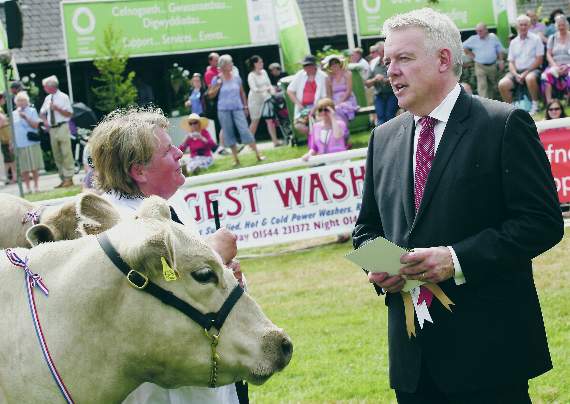
WALES’ First Minister is to discuss the implication of the UK’s decision to leave the European Union with key figures from agriculture today.
Carwyn Jones is hosting the round-table discussion in Cardiff with his environment and rural affairs secretary Lesley Griffiths.
Farming union leaders, rural business-people and representatives of environmental bodies will be among those attending this afternoon’s meeting.
The First Minister said: "There is no doubt Britain’s decision to leave the EU has caused uncertainty for the environment and agriculture sectors considering the substantial levels of funding and support the EU provides. Indeed, out of all areas of Welsh Government business, environment and rural affairs are those most closely linked to the EU."That is why, since the referendum result, meeting key figures within these sectors has been one of my top priorities."Today is the start of a long, uncertain journey and I will not make any promises that I will have all the answers. What assurance I can give however is that I will work tirelessly to seek guarantees from the UK Government that Wales will not be financially worse off as a result of the UK leaving the EU."We will be in listening mode today. Nothing will be off the table and I will ensure the views raised will be at the very forefront of my mind when I am negotiating with the UK Government over the timing and terms of the UK’s withdrawal from the EU”.

Powys benefits from around £80m in farming subsidies paid under the EU’s Common Agricultural Policy (CAP).
Meanwhile the NFU Cymru farming union is to hold a special meeting of its governing body, the Welsh Council, on Tuesday, July 5 to begin to consult on the key priorities for a post Brexit Wales.
Its deputy president John Davies attended a meeting in Brussels last week to discuss future of sheepmeat.
The Merthyr Cynog farmer said: "The UK produces 39% of the EU’s total sheepmeat production, therefore are a key player in that market and one of the sectors that could be most affected when the UK officially leaves the EU.
"It is now vitally important that trade negotiations get underway at the earliest opportunity, to ensure that when the UK officially leaves the EU we will be able to maintain the best possible access to the EU and to countries across the world. Welsh sheep farmers are particularly reliant on export markets and we will be looking to the UK Government to prioritise the negotiation of favourable trade agreements.
"At present, the EU holds 11 free trade agreements with countries across the world, five more have been concluded and there are a further 14 agreements currently under discussion.
"The UK must now aim to set up a similar number of agreements to ensure that we can export our goods to as many countries as possible. However, it is essential that decision makers do not undermine domestic agriculture by opening the UK market to goods which do not meet our own high standards of production."