

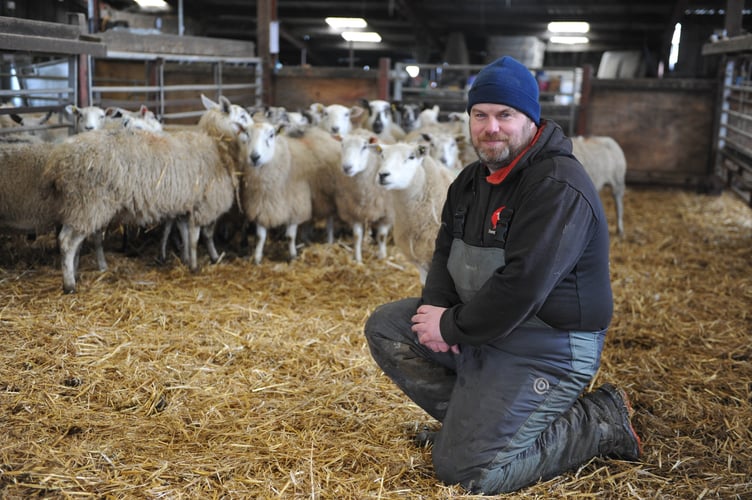
High-quality clover silage has helped a Powys sheep farm cut its feed bill and improve lamb performance.
At Awel y Grug, near Welshpool, father and son Glyn and Chris Davies run 700 Welsh Mule and Texel-cross ewes. Concentrate feed had long been one of the biggest costs on the farm, especially for twin-bearing ewes. But rising prices, combined with a desire to reduce the flock’s carbon footprint, prompted the family to try something different.
Through Farming Connect’s Our Farms network, the family trialled red and white clover silages, and the results were striking. Independent sheep consultant Kate Phillips calculated that supplementary feed costs dropped by £1.85 per twin-bearing ewe and £2.31 per single-bearing ewe during the 2025 lambing season. Across 500 ewes scanning at 150 per cent, that meant around £1,040 saved over the eight-week housed period.
Further savings came from labour and improved lambing outcomes. Phillips said the benefits were driven by “good strong lambs and high-quality colostrum.”


The trial compared red and white clover silages fed to ewes in the last eight weeks of pregnancy. Silages had an average ME of 10.8 MJ/kgDM, with protein content influencing the type of supplement required.
Ms Phillips explained: “The energy and protein content varied therefore different supplements were needed to balance energy and protein intakes - the high protein samples simply needed an energy supplement like sugar beet pulp and the lower protein samples some additional protein in the form of a compound feed no higher than 18 per cent crude protein.”
Twin-bearing ewes consumed an average of 14kg of compound at a cost of £4.62/head or beet pulp at £3.50/head, compared with 18kg per ewe in previous years. Single-bearing ewes only required 4.2kg/head of compound feed for yearlings.
Ewes lambed from March 28 and Ms Phillips reported that birthweights were good and, for the size and breed of ewe, considered “above average’’.
She said: “Single born lambs from mature ewes, whether on red or white clover, had birthweights approaching 5kg, apart from the yearlings which delivered slightly smaller lambs, but this was not unexpected given that they were at least 12kg lighter than ewes in other single bearing groups.”
Twin lambs from red clover-fed ewes averaged 4.24kg, slightly higher than 4.18kg from white clover-fed ewes. Colostrum quality exceeded the target Brix score of 26.5 per cent.
For the Davies family, the savings highlighted by this trial have been significant but across the business, when other factors are considered, they estimate much bigger savings in the sheep system, as much as £8,000 to £10,000 a year.
“We reckon that across the business we are using a quarter of the concentrates we were feeding,’’ said Chris.
“The farm has improved tremendously because of the whole Farming Connect project; it has been unreal.
“By growing clover and improving permanent pasture and rotational grazing we are seeing better lamb growth rates, ewes are performing better.’’
Comments
This article has no comments yet. Be the first to leave a comment.