

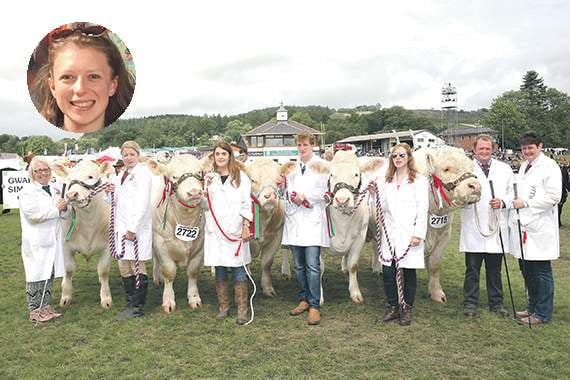
University graduate Rosie Toy, from Crickhowell, spent a week working with the B&R’s news team to see if journalism is the career for her. Here are her impressions after spending most of the week at the Royal Welsh Show.
AS an outsider to the farming community, visiting the 2017 Royal Welsh Show was a real eye-opener for me.
The Llanelwedd showground was a hub of agricultural activity, and seems to be the pinnacle of the farming year.
Having previously thought that the Show could only be enjoyable if you come from a farming family, I was pleasantly surprised by the amount of attraction it has for people from any number of different backgrounds.

I saw competitors and performers who had travelled internationally to come to the show, as well as important political figures, such as First Minister Carwyn Jones and MP Michael Gove.
According to their website, the Royal Welsh Show exhibits up to 20,000 car loads of livestock as well as hundreds of lorries and trailers, which attract 50,000 people through the gates every day.
Across Wales over 58,000 people work in the farming industry which covers 80% of Welsh land and the Royal Welsh Show exhibits the finest that Welsh farming has to offer.
Due to the number of local farmers and small-holders in the sheep competitions, we spent a lot of our time at the sheep pens finding out more about the prize-winning animals and their handlers.
Many of the people we spoke to were not full-time farmers and instead hold other careers in different areas. It was this that made me wonder if farming was a particularly profitable industry or if farmers needed to top-up their earnings with other employment as a matter of course. NFU Cymru reported in December 2016 that farming business income for ‘all farm types’ averaged at £22,000 for 2015-16, and according to the latest forecast is due to rise by 16% in the coming year.
However, the income for farming families is much lower, as NFU Cymru President Stephen James advised in December: “The impact on farming families is even more starkly highlighted by the net farm income figures for 2015-2016. Net farm income is the return to the farming family for their labour after costs such as rent, depreciation and interest payments, and this income fell by around 37% to £11,000.”
It is no wonder that the farming community is concerned with the looming uncertainty of Brexit which threatens the EU’s Basic Payment Scheme.
The aim of the Royal Welsh Agricultural Society is to support agricultural life, and the Show is dedicated to the promotion of Wales’ best farming. Although Brexit discussions did occur during the show, the show lived up to its pledge and farming worries were veiled by the excitable crowds and lively exhibits.
The awards given by the show do help the farmers, Christie Joseph from Sennybridge said: “The award will be very good for advertising our flock, as the prizes help to sell the animals.”
Furthermore, the Show’s ability to attract people from all walks of life to take interest and enjoy the success of agricultural society in Wales is phenomenal, and despite the difficult climate forecast for farming in the wake of Brexit suggests hope for the future of the Welsh farming industry and its continued importance to the Welsh economy.