

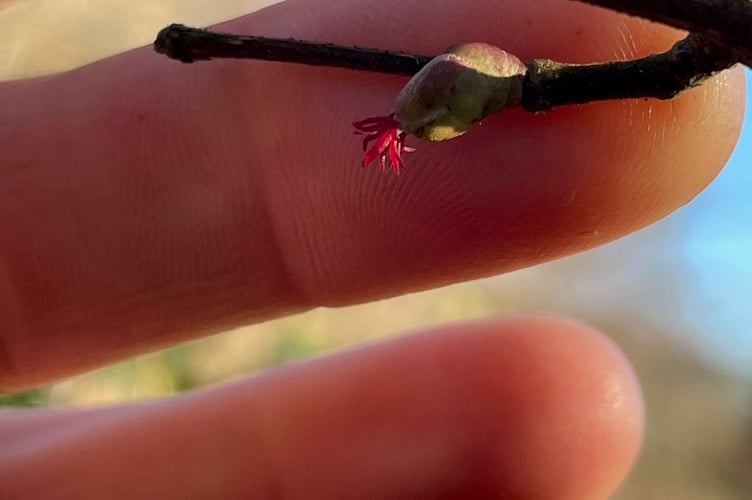
It’s the time of year for one of my very favourite things and something I write about and share enthusiastically every year. The hazel flower. And because I’m a creature of habit, I always go to the same tree and keep checking for her arrival. And last week, there she was, making me ‘smile out loud’.
I think it’s the fact that the tiny little red spiky hazel flower is so understated and overlooked and yet so absolutely pivotal in an aspect of nature that we all recognise, that hooks me every year.
And whilst on the subject of being enamoured by nature’s wonders, I can highly recommend growing a Leaf of Life plant (Kalanchoe Pinnata). Also known as Miracle Leaf, it’s not difficult to see how it gets these lofty names.
There are several magical things about these plants. They actually grow from just a single leaf, producing a profusion of miniature plantlets on the edges of that leaf. I think it is one of the most fascinating things I have seen for a long time – other than my hazel flower, of course.
Despite looking quite diva-ish, it is a very low maintenance plant, which is almost impossible to ‘accidentally kill’. That makes it perfect for enthusiastic little green fingers as well as the older gnarly, arthritic ones!
One of my favourite descriptions of it is as ‘a herbal remedy for stress and anxiety, with its calming effects helping promote relaxation and alleviate tension.’ I think you would only have to watch the little plantlets develop as magically as they do, to forget about any anxiety and tension in your life.
As the carpets of snowdrops continue to impress, I love looking into the little bowed flower -heads to see the different petal patterns and varieties.
There are over 2,500 named cultivars too, adding to the wide array of petal size and shape. If you look inside the flowers, the intricate patterns will amaze you and it’s easy to see why these beautiful early bloomers have such a dedicated following. Fans of the snowdrop are known as Gallanthophiles and some varieties are much sought after by avid collectors. The most expensive snowdrop ever sold is the Galanthus plicatus 'Golden Tears', which fetched £1,850 for a single bulb four years ago. That was a sharp increase on the most expensive snowdrop bulb bought at auction in 2011, Galanthus 'Green Tear' which sold for £360 then.

I always watch the honeybees visit the flowering white carpets as an early source of food, but I haven’t seen a single honeybee yet this year. The honeybees, and Bumblebees, will visit, and reverse out of these bowed white lampshade flower-heads, with orange pollen in their pollen baskets on their back legs. The bright orange dots are vivid and seem highly unlikely to have come from such a pure white flower head. The flowers are clever too, and outer segments of snowdrops can move in response to changes in temperature. When air temperatures are above 10°C, pollinating insects such as bees are more likely to be flying, and so the petals move upwards and outwards, opening the flower to allow easier access. That’s proper collaboration.
Whilst folklore has it that is unlucky to bring snowdrops into the house (it is said that a death will follow), I always take the chance and display a small vase of the little beauties from my garden on a mirror tile. It is a lovely way of enjoying the beautiful interiors of the otherwise unseen interiors.
As Aristotle said, "In all things of nature there is something of the marvellous.”
Comments
We've recently changed our login process. If you have an account for commenting, you will need to re-register on the login window.
This article has no comments yet. Be the first to leave a comment.