

I am so glad that, after nearly 60 years on this glorious planet, I am still impressed and fascinated by the little things in life. This week it has been caterpillar poo. Or more to the point, the size or quantity of poo a caterpillar produces. When Yogi and I were on one of our sniffari’s this week, we spotted our neighbour (Doris) inspecting something in the hedgerow. It turned out that she was looking for the Scarlet Tiger moth caterpillar. She had already spotted the caterpillar poo on the green alkanet leaves, which had given away its probable proximity. It wasn’t long until we spotted it and I highly recommend the whole ‘process’, as an educational form of mindfulness.
Not one for waste, I have been busy ‘making’ my own bamboo canes. After cutting back a rampant bamboo at home, I spent ‘an age’ pulling off the side shoots to get clean canes, which I will be able to use in the garden. The common bamboo is not a user-friendly plant at all, with limited appeal – unless you are a Panda - although it does have a cool name, ‘Bambusa vulgaris’.
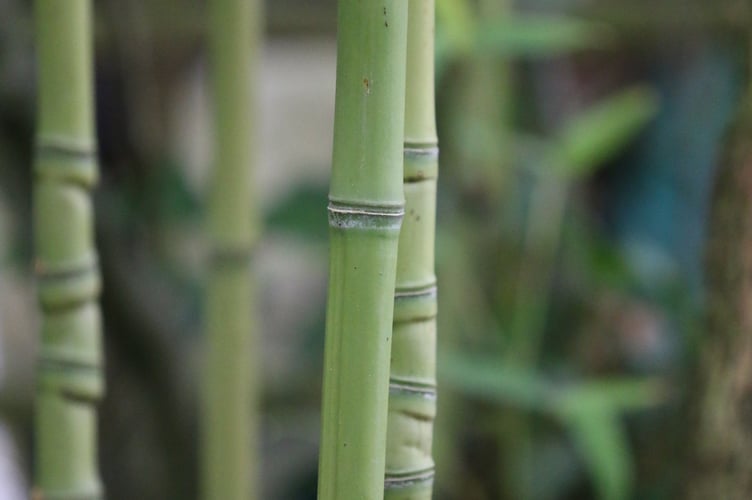
Not only is it invasive, and really, really, really tough to cut back, it can cheerfully give you a painful unexpected rash. Using ordinary secateurs to cut it back will almost certainly result in carpal tunnel syndrome, so I used the Stihl battery pruners (www.stihl.co.uk). They are a ‘blinking brilliant’ tool but please be careful if using them, as they are razor sharp and once switched on, once you touch the trigger, they close rapidly. That, without going into detail, gives you no option to release and stop the ‘cutting action’, so make sure your ‘free hand’ is well out of the way of the blades. Anyway, I am happy to report that I now have a huge stash of clean, homegrown bamboo canes that will be put to good use in various gardens. And all my fingers.
I’m sure you have noticed just how much blossom is around this year. All the flowering shrubs seem to be laden with flowers, with the Red Robins (Phontinia’s ) being a good example. Whilst it’s lovely to see, and great for the insects, Dad always used to say that particularly prolific flowering was a sign of the plant being stressed. It therefore produces as many flowers (and therefore seeds) as possible to try and ensure it’s continued survival. It’s easy to forget that plants flower for their own reasons and benefits, not ours. Many shrubs are overlooked for their seeds, and Photinia ‘Red Robin’ is a hybrid shrub that does not ‘come true’ from it’s own seeds. That means you won’t get an identical plant, and which is why propagation is always through stem cuttings.
And that reminds me – I have seen a lot of smaller ‘Red Robins’ looking a bit leaf-less at the moment, whilst still being heavily in bloom. Even evergreens ‘change’ their leaves every year and I think if you look carefully at the bare branches you will see little red shoots which means the new leaves are on their way. I think the shrubs have been a bit energy-depleted this year, due to the heavy blossoms, and the leaves have paid the price, being slower to renew. Don’t panic, they’ll soon leaf up – nature has a fabulous way of restoring balance in her own time.

And of course, we are just coming to the end of this year’s Chelsea Flower Show. I’m enjoying it from the comfort of my sofa this year and look forward to sharing some of my thoughts in next week’s column.
Comments
We've recently changed our login process. If you have an account for commenting, you will need to re-register on the login window.
This article has no comments yet. Be the first to leave a comment.