
Proposals to centralise urgent medical care at two sites in Powys could push residents to seek emergency medical attention in hospitals outside the county.
At a Powys Teaching Health Board (PTHB) board meeting on Wednesday, September 16, members discussed proposals to move to a consultation on a set of options that could cause the biggest shake-up of health provision in the county for decades.
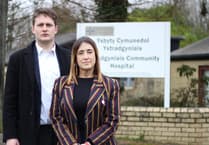
Options to centralise urgent care at sites in Brecon and Newtown have already received much criticism.
This is because under one option the MIUs at Welshpool, Ystradgynlais and Llandrindod Wells would be lost.
A second urgent care option would see a “minor illness and injury unit” at Llandrindod Wells alongside the urgent care centres in Brecon and Newtown.
Powys County Council’s director of Social Services, Nina Davies, is an associate board member, which means she can sit in and speak in meetings, but not vote on proposals.
Mrs Davies asked: “What assumptions have been used to model that future demand and the viability of the proposals, under both the two and three site options?
“Significant numbers of residents in the north, mid and south of the county may choose to access geographically closer and more extensive services outside the county.”
She wanted to know how this “potential transfer of demand” from the MIUs to out-of-county hospitals had been evaluated.
Mrs Davies added that the council will formulate its own response to the proposals once the consultation is underway.
Independent board member Dr Rhobert Lewis added: “For people living at the extreme ends of the county this might well initiate quite a lot of anxiety. What are the implications for residents’ access to minor injury and enhanced care?”
The concern is that rather than travel to Newtown, residents of Welshpool and villages to the north of that town would go to a district general hospital in Shrewsbury for treatment.
Likewise, people in Radnorshire would travel to hospital in Hereford, and residents in Ystradgynlais and the surrounding area would go to Swansea instead of the urgent care unit in Brecon.
Medical director and acting deputy chief executive Dr Kate Wright answered: “One of the things we will want to hear in the consultation is what the impacts might be on the population.
“In terms of the MIU provision, the proposed model described is an enhanced offer.
“At the moment our MIUs do a good job but they are only able to provide limited services, often without X-ray provision.
“Under the new model many more conditions can be treated in county so that people wherever they live won’t need to be treated out of county.”
She added that an “awful lot” of urgent care could be conducted in the community or primary care settings such as medical practices.
Ms Wright continued: “A really important part of this model is that urgent care could be provided in people’s homes without going to any centre whatsoever and avoiding the need to travel.”
She believed there would be a need to “carefully evaluate” comments made during the consultation on these proposals.
This could tell PTHB whether there is a need for “appropriate mitigation” in the final proposals to continue with some semblance of the current model.
Director of improvement and transformation Lucie Cornish said: “The modelling work has made assumptions of people travelling to their nearest centre.
“We have noted in the pre-consultation business case the significance of travel and transport feedback through our engagement and we expect that to continue through the consultation.
“We know it’s a key area of concern and we have undertaken travel time analysis both from private and public transport perspectives.”
The 14-week consultation is due to start on October 5.
Comments
This article has no comments yet. Be the first to leave a comment.