
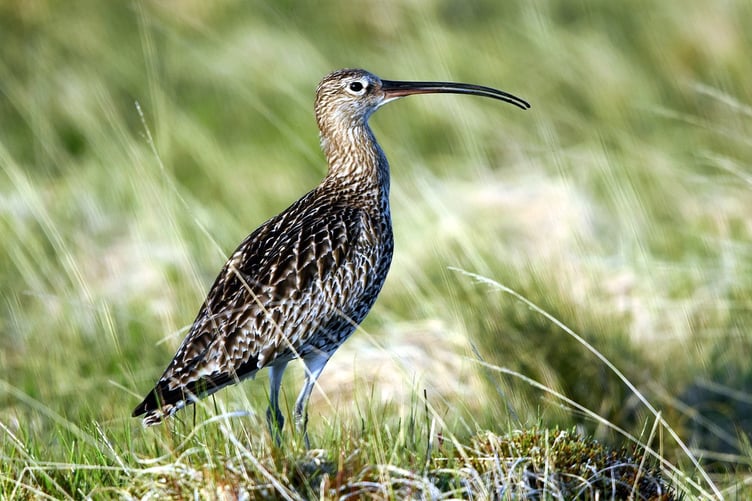
The curlew has more than 25 different names in Welsh, members of Bannau Brycheiniog National Park Authority were told.
Members of Bannau Brycheiniog National Park Authority (BBNPA) welcomed a refreshed and updated plan to help the curlew’s recovery in Wales at a meeting on Friday, October 9.
The 10-year plan was established in 2021 and has been refreshed following a review of its implementation and to take on board the lessons learned so far.
This is part of an attempt by Gylfinir Cymru (Curlew Wales) to seek cross-party support in the enlarged Senedd and endorsement by the new Welsh Government of its work.
Other parties in Gylfinir Cymru are also expected to endorse the updated plan during this month.
Earlier this year, BBNPA was successful in its bid to the Nature Networks 5 programme, administered by the National Lottery Heritage Fund, to work in partnership with the Clwydian Range and Dee Valley National Landscape to build upon the conservation work already done under a previous scheme called Curlew Connections.
BBNPA ecologist Nicola Davies said: “We’ve already recruited five staff as predator controllers and an evaluator for the Curlew Landscapes Wales project that commenced in May, and we will be employing more throughout the duration of the project.
“The Nature Networks Fund will be supporting three years of curlew recovery in Bannau Brycheiniog.
“They are known as an umbrella species, meaning if you look after curlews, you’re looking after a wide range of habitats and species, resulting in more biodiverse landscapes, with increased pollinators, healthier soils and increased water retention.
“Curlews have 25-plus names in Welsh, demonstrating they are deeply rooted in our culture, and if we lose them, we lose that connection to the land.”
BBNPA chairman Cllr Gareth Ratcliffe reminded members that this is “an all-Wales action plan”.
Welsh Government-appointed member Canon Aled Edwards, who originally hails from Trawsfynydd in North Wales, said: “I’m a Merionethshire boy and I’m used to calling the curlew Gog-y-Cwm, which means Cuckoo of the valley.
“It’s a wonderful expression of the diversity of this particular species in our midst, and I think us taking part in enhancing that diversity and the richness of the bird is fantastic.
“I wholeheartedly support this.”
Cllr Peter James (Powys) asked: “We have six (curlew) breeding areas in Bannau. Has that been affected at all by wildfires?”
Ms Davies said: “We have been monitoring curlew territories for six years and have a good understanding of where they breed.
“It’s unlikely that they are breeding in wildfire areas. They appear to be on lowland or mid-upland habitat rather than on the mountain tops.”
Cllr Huw Williams (Powys) said: “Over the six years, we had that Covid-19 period where people were not as active in the countryside.
“On reflection, did that have a positive or negative effect on the curlew population?”
Ms Davies said: “There’s no solid evidence to prove this, but if there were fewer people walking around in the countryside, the curlew would have a stronger chance of producing chicks to fledge and a better chance of survival.”
Members went on to approve the report.
Comments
We've recently changed our login process. If you have an account for commenting, you will need to re-register on the login window.
This article has no comments yet. Be the first to leave a comment.