
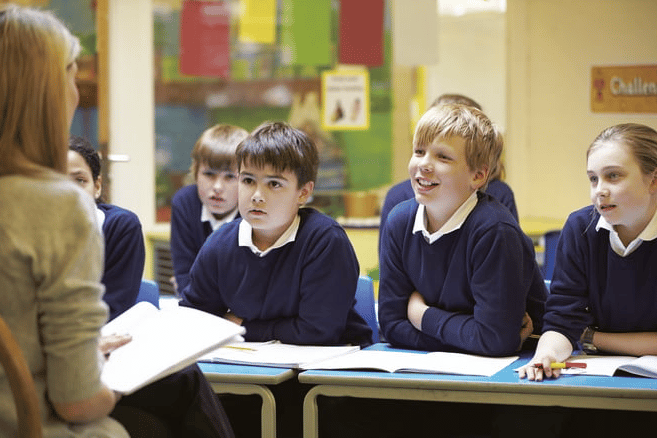
There will still be winners and losers amongst Powys schools even after the latest tweaks are made to their funding formula, a senior councillor has admitted.
At a meeting of Powys County Council’s Liberal Democrat/Labour Cabinet on Tuesday, January 20, senior councillors received a report which explained how the schools funding formula could be re-jigged to allow a further £1.8 million to be pumped into schools.
Education portfolio holder Cllr James Gibson-Watt (Liberal Democrat – Glasbury) explained that changes would be made to funding in both the primary and secondary school sectors and follow a consultation that took place from the end of September to November 6.
Cllr Gibson-Watt said: “It’s important we keep the funding formula under constant review and updated to reflect changing circumstances.
“Ultimately this is to produce a more equitable system than we currently have.
“But inevitably, because of the range of schools we have, particularly across the primary sector, it is very hard to achieve. It will produce winners and losers.”
Cllr Gibson-Watt added that he was “disappointed” to see that only 17 responses had been received during the consultation from the county’s 80 schools.
Deputy council leader Cllr Matthew Dorrance (Labour – Brecon West) said: “There is much in this report to be welcomed, particularly around additional resources for the secondary school sector. It’s a step forward.”
But he was concerned that small primary schools will continue to receive a “subsidy” in the form of a top-up.
“That feels unfair to me,” said Cllr Dorrance.



Cllr Gibson-Watt said that the council’s problem is the geography of Powys, as well as the number of primary schools that have 50 to 150 pupils.
Cllr Gibson-Watt said: “The vast majority of our schools are in that category and require a degree of top-up in order to allow them to be staffed adequately to deliver the curriculum.”
He conceded it was becoming harder to “justify” the redistribution of funding through top-ups, as it affects pupil results in bigger primary schools.
Cllr Gibson-Watt believes that in future the council will need to concentrate on the child and results, because “how they do in school” decides their life chances.
“This will help but it can’t be the end of the story,” said Cllr Gibson-Watt.
He added that continuing the programme of schools transformation would also need to play a part in the process.
Director for Education Dr Richard Jones said that agreeing the proposals ensures that no individual pupil is penalised because they attend a small school.
Dr Jones said: “What the top-ups do is allow our teachers to better plan and know individuals in schools.”
Schools finance business partner Nancy Owen said: “Every school in Powys starts off with the same amount of funding per pupil.”
This amount then changes due to location, number of pupils and size of school being added into the equation.
Councillors voted to support the move.
Agreeing the £1.8 million funding boost for schools will form part of a budget proposal for 2026/2027 that takes the schools delegated budget up to £103.872 million out of a total £390.541 million, which will be debated by councillors at a meeting on February 26.
Comments
We've recently changed our login process. If you have an account for commenting, you will need to re-register on the login window.
This article has no comments yet. Be the first to leave a comment.