

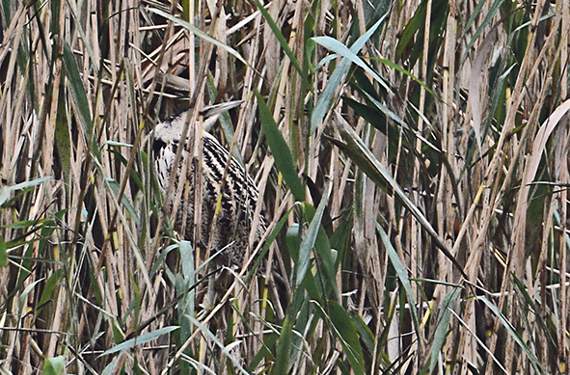
One of Britain’s rarest birds has been spotted among the reeds of a Mid Powys lake.
A Bittern, which is a member of the heron family, has been seen resting in the reeds at Llandrindod Wells Lake in recent days.
The Bittern is a secretive bird that is very difficult to see as it moves silently through reeds at the water’s edge as it looks for fish and other prey. This very exciting discovery has come to light thanks to local nature enthusiasts and regular twitchers of www.Radnorbirdblog.co.uk, who have spotted the rare bird amongst the reeds at the lake.
The reeds were planted by Powys County Council as part of a major lake regeneration scheme to restore the ecological balance of the lake after the events of 2006 where, following a hot summer, thousands of fish died from oxygen starvation caused by a breakdown of blue-green algae.




The Bittern adds to the growing list of species that have returned or are now visiting the lake since the restoration works were completed in 2009. Otters, Kingfishers, Reed Buntings, Reed Warblers, Sedge Warblers, Cormorants, Little Grebes and Great Crested Grebes have all benefited from the improved fringe habitat.
There has also been a wonderful mix of Damsel flies, various Dragonflies that breed there along with so many other invertebrates. This has provided a richer fauna as the years go by, creating a more complex and fruitful food chain, all since the extensive ecological transformation was completed.
Cllr Graham Brown, Cabinet Member for Outdoor Recreation, said: “We’re immensely pleased that Llandrindod Wells Lake has attracted one of Britain’s rarest birds.
“The presence of the Bittern proves once again that the efforts made to restore the ecological balance of the lake are working. If we did not plant or manage the vegetation that currently exists at the lake, it is unlikely we could have attracted this rare bird to the area.
“Our goal was always to achieve a robust ecology for Llandrindod Wells Lake balanced by the needs of others who gain recreational enjoyment from it. With such a rich ecology now developed, it is no wonder bird watchers are coming from across Britain to see what is on offer, which is also boosting local tourism.”