

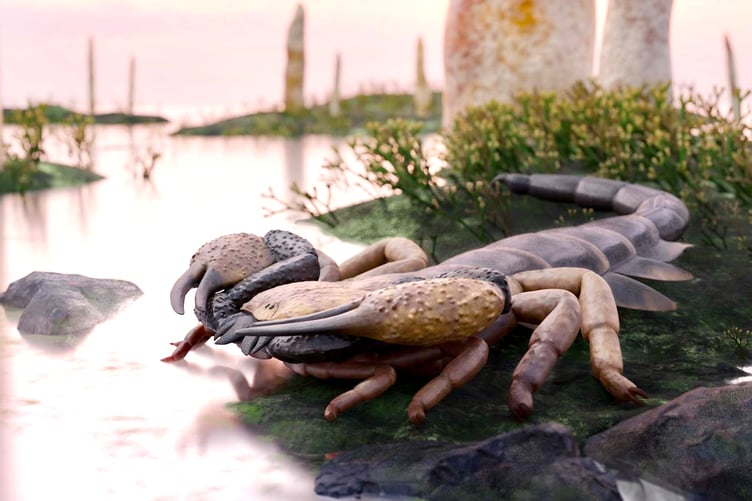
Fossils found near Talgarth have been identified as belonging to the largest scorpion ever known to have lived on Earth.
The creature, about the size of a large dog, lived around 415 million years ago.
The giant arthropod, Praearcturus gigas, has been confirmed after an 18-year study by researchers at the Natural History Museum.
The fossils were found in St Maughan's Sandstone across parts of the Welsh borders, including Tredomen Quarry near Talgarth, Longtown in the Black Mountains, and Rowlestone, where the first specimen was discovered in 1871.
-and-Gareth-Hughes-(Llanyre-with.png?width=209&height=140&crop=209:145,smart&quality=75)



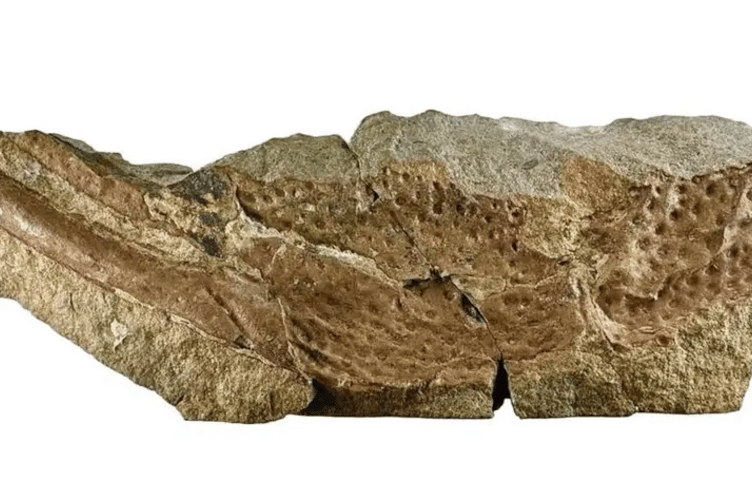
The species was first described by English palaeontologist Henry Woodward. He originally thought it was a woodlouse-like crustacean. That interpretation is reflected in its name, derived from Arcturus, a group of living woodlice.
For more than a century, its identity remained uncertain. New research and modern analysis have now confirmed it as a scorpion.
The study places the animal in the Early Devonian Period, when life on land was still developing and large predators were rare.
Scientists say its size would have made it one of the dominant predators of its time, hunting both on land and in water.
Although the full length from pincers to tail cannot be precisely calculated, scientists can compare preserved parts with other scorpions.
One claw measured around 16cm – comparable to, or slightly larger than, modern giant scorpions such as the emperor scorpion, which typically grows to around 15–20cm.
Dr Richie Howard, the lead author of the study and the Natural History Museum's Curator of Fossil Arthropods, said: “When we think of giant arthropods, people tend to think of enormous millipedes like Arthropleura or the dragonfly-like griffinflies.
"But these species lived in the Carboniferous Period at least 55 million years after Praearcturus, once land-based ecosystems had time to develop.
“Instead, Praearcturus lived when life on land was just starting out and the ancestors of reptiles, mammals and birds were yet to leave the water.
"It suggests that this species might have grown so big because there weren’t any other large predators, allowing it to dominate its environment.
"Confirming that this animal is a scorpion fundamentally changes our understanding of how and when these creatures evolved to such extraordinary sizes."
Scientists used modern imaging techniques and compared fossils with newly described species to confirm its identity.
The earliest remains were found in Rowlestone in 1871 by Henry Woodward, around 10 miles north of Abergavenny.
In the 1980s, scientists first started to suspect that Praearcturus might actually be a scorpion, boosted by the discovery of an ancient specimen called Eramoscorpius in Canada in 2015, which displayed internal structures almost identical to the local fossils.
“Without complex ecosystems to support Praearcturus on land, these animals probably spent part of their lives hunting in water,” said Dr Howard.
“Some of the fossils found in Wales show that they had flap-like structures known as epimera that are similar to those found in lobsters and crabs.”
The St Maughan’s Formation is a Lower Devonian geological formation in Wales, recognised for its ancient red sandstones.
Comments
This article has no comments yet. Be the first to leave a comment.