
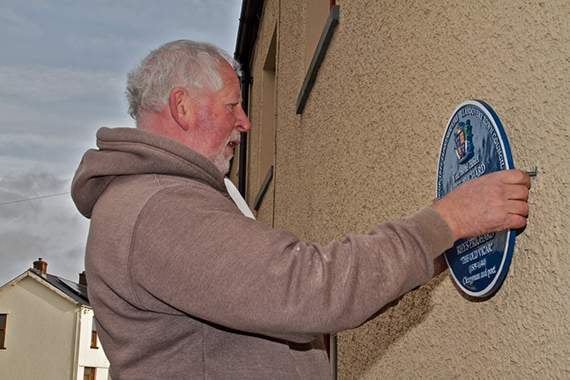
Llandovery got its first ever blue plaque last month when East Dinefwr AM Adam Price unveiled a plaque to the immortal memory of vicar Rhys Prichard (1579-1644).
David Lloyd George on a visit to Llandovery some 105 years ago had expressed surprise that Llandovery had not made more of the memory and status of one of its most famous sons in clergyman and poet Rhys Prichard.
It might have taken more than 100 years but the vicar’s name and renown were at last honoured in the Vicar Prichard Assembly Rooms where Mr Price, the newly elected Plaid Cymru leader, told a crowd of people that Revd Pritchard was one of Llandovery and Wales’s greatest men.
It was fitting that Llandovery’s first ever blue plaque was attached to the wall of the vicar’s house in 33 High Street, Llandovery, current home of the Phelps family.
The blue plaque project was set up to identify people, places, icons, events and buildings of cultural and historical worth.
On the initiative of Llandovery Town Council and Camarthenshire county councillor Handel Davies, the unveiling of the memorial to Prichard will serve as a reminder to locals and visitors alike of the permanent fame and renown of the scholar.
The Llandovery Town Council has plans to set up future plaques in the town to commemorate the other people and sites that hold a special place in the history of Llandovery, notably the greatest of all Welsh hymn writers William Williams of Pantycelyn.
Vicar Pritchard was the author of many works, the most famous being Cannwyll y Cymry (The Welshman’s Candle), first published in 1659, a collection of poetical teachings and moral guidance and one of Wales’s greatest literary works.
With the Bible it was for a long time one of the two books found in almost every Welsh home at a time when there were few books in circulation.
Rhys was born in his parents house, 33 High Street Llandovery in 1579 and graduated from Jesus College Oxford in 1602, ordained as a priest at Witham in Essex before being appointed Vicar of Llandingat and Llanfair-ar-y-bryn in 1594.
There is a well-known story that in his teens he was converted from the ways of sin to be a faithful follower of Christ. Apparently he had a goat which accompanied him everywhere, both were involved in a drinking session resulting in the animal becoming drunk!
Following this incident Rhys never frequented any hostelry and became teetotal. His writings were moral, religious and didactic as well as popular in theme, in a language that the ordinary man could now understand, hence its importance of reaching a far wider audience of Welsh people.
Local historian David Gealy, former Head of English at Llandovery College who has been collecting early editions of Cannwyll Y Cymry brought along for general viewing a selection of copies, the finest an 1680 edition and a further copy of the first translation into English dated 1888.
Dr R Brinley Jones, former Warden of Llandovery College, who has written a book on Prichard was also present at the plaque ceremony to remind Welshmen of the debt they owe a man whose influence in propagating the Welsh language was of crucial importance to the nation.