
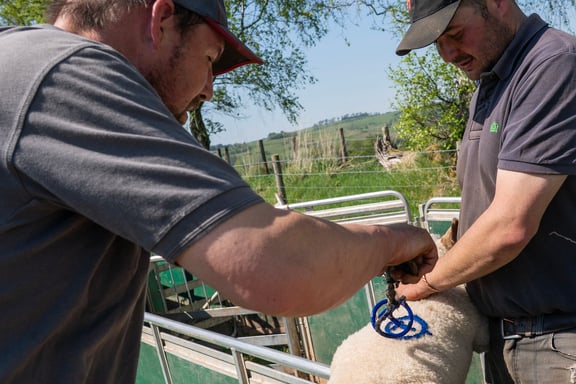
Keeping track of more than 6,000 breeding ewes spread across seven hills and 12,500 acres of upland grazing is no easy task.
Yet despite advances in electronic identification technology, Estate Manager James Lloyd still relies on a simple pitch mark to identify sheep, record breeding lines and protect stock from theft.
For Mr Lloyd, who manages a flock predominantly made up of Brecknock Hill Cheviots at Cnewr Estate near Brecon, reliable identification is essential. Each of the seven hills carries its own distinctive pitch mark, while management tags are used to identify sire lines and support breeding decisions.
"Both the pitch mark and the ear tag provide quick visual identification of the animals and tell us which hill they belong to. It also helps with breeding decisions, as the tag identifies the sire," says Mr Lloyd.
-Chris-Walsh-Liz-Rijnenberg-Matthew-Dorrance-and-David-Meredith-who-will-be-h.jpeg?width=209&height=140&crop=209:145,smart&quality=75)



"This is a system that we have relied on for years and it works. Whenever we gather sheep, whether at lambing, weaning or before our on-farm sale, we need to know where the animals have come from and what their breeding is."
While EID technology plays an important role in flock management, particularly for grouping sheep and recording breeding information, Mr Lloyd says visual identification remains fundamental.
"We use EID to identify which rams lambs have been sired by and to avoid inbreeding,” he says.
“But from a management point of view, having a clear and reliable pitch mark is vital. We can easily see from a distance whether ewes and lambs are on the correct hill simply by looking at their pitch."
To ensure the marks remain visible throughout the year, the estate has used Nettex Promark branding paint since it was first introduced more than a decade ago.
"We know that when we use Promark, the mark will still be visible up to 12 months later," he says.
"It also needs to be readable when you apply it. You can't be using a product that is too runny or too thick. Consistency is important if you want a clear mark."
Mr Lloyd's chosen pitch mark is a 'T' enclosed within a circle. The position of the mark on the sheep varies depending on which hill the animal belongs to, while different colours are used to distinguish between hills and stock type.
"Having a clear pitch mark allows us to make informed decisions and maintain reliable visual management records, helping us continue to develop the flock's genetics and overall performance," he says.
The marks are applied shortly after shearing to breeding ewes retained within the flock, while lambs are marked in early June.
Genetic improvement is a key focus for the family. The estate's annual on-farm sale, which takes place in the third week of September, has been running for more than 150 years and attracts buyers looking for high-quality breeding stock.
The estate uses between 15 and 20 tins of Promark each year, with a single tin typically covering between 500 and 600 sheep, depending on the size of the branding iron used.
Comments
We've recently changed our login process. If you have an account for commenting, you will need to re-register on the login window.
This article has no comments yet. Be the first to leave a comment.