

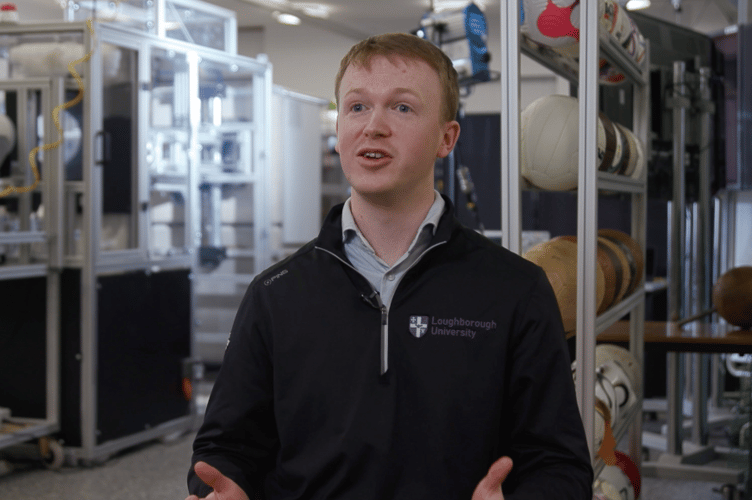
A scientist who grew up in the Brecon Beacons has helped lead groundbreaking research into how football headers affect the brain.
Dr Ieuan Phillips, a former pupil of Gwernyfed High School and Llangorse Primary School, is the lead researcher on a new study from Loughborough University that has identified a previously unknown way energy from heading a football is transferred into the brain.
The findings could play an important role in understanding the long-term health risks associated with the sport.
Football remains the world’s most popular game, played by an estimated 260 million people and followed by billions more. But concerns have grown in recent years about the impact of repeated headers, with studies linking them to a higher risk of neurodegenerative diseases later in life.




Now, this latest research has uncovered a new piece of the puzzle.
Using an advanced model of the human head, researchers simulated real match conditions by firing balls from different eras at typical heading speeds. Inside the model, a specialist pressure sensor allowed scientists to observe what happens within the brain during impact.
For the first time, they detected a distinct pressure wave moving through the brain, transferring energy into the frontal region.
Crucially, the study found that the level of energy transferred varied dramatically depending on the type of football used - with as much as a 55-fold difference between older and modern designs.
Dr Phillips said the discovery opens the door to safer equipment in the future.
“These findings provide opportunities to work towards ball designs and testing specifications that minimise energy transfer into the brain,” he said.
“We look forward to collaborating with all stakeholders interested in taking this forward.”
Professor Andy Harland, Professor of Sports Technology, Loughborough University said: “Having studied football impacts for two decades, I am pleased we have been able to find evidence of this pressure wave and quantify the energy that is being transferred into the brain during each header. There is still much work to do before we fully understand what this means for brain health, but this research allows us to provide a much more detailed description of how energy is transferred during heading.”
The study was funded by the The Football Association as part of ongoing efforts to better understand player safety.
FA Chief Medical Officer, Charlotte Cowie, said: "We’re pleased to have funded Loughborough University’s study into the potential effects of pressure waves in footballs. This new independent research provides us with innovative and previously undiscovered insight – and it is part of our ongoing commitment to gain a greater understanding of this highly complex area.”
“The results of the study have also been shared with FIFA and UEFA, and we continue to welcome a global approach to support further research in this important area,” she added.
The research has been published in the peer-reviewed Proceedings of the Institution of Mechanical Engineers: Journal of Sports Engineering and Technology.
The full paper can be viewed online here: https://doi.org/10.1177/17543371261438388
Comments
We've recently changed our login process. If you have an account for commenting, you will need to re-register on the login window.
This article has no comments yet. Be the first to leave a comment.