

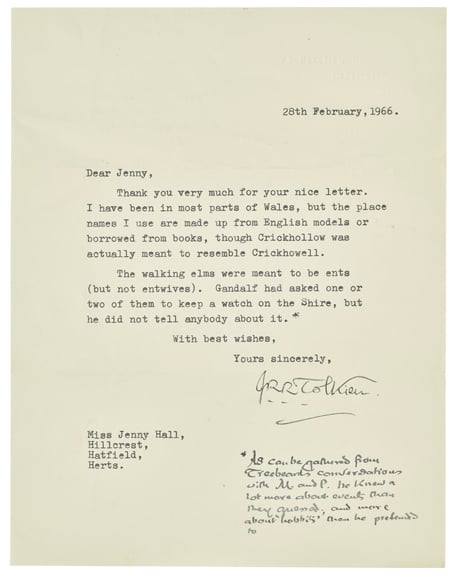
A newly surfaced letter signed by J.R.R. Tolkien is set to go under the hammer next month - and it appears to offer rare, direct evidence linking Middle-earth to the Crickhowell area.
The typed and signed letter, currently listed by Christie’s, is expected to fetch between £5,000 and £7,000 when it is auctioned in London. But for those from this neck of the woods, its real value may lie in a single line that has reignited long-standing local folklore.
In the 1966 correspondence, written to a reader named Jenny Hall, Tolkien responds to questions about place names in The Lord of the Rings and the inspirations behind them. In doing so, he draws a direct comparison between his fictional Shire and the Welsh landscape he knew.
“I have been in most parts of Wales,” he writes, “but the place names I use are made up from English models or borrowed from books, though Crickhollow was actually meant to resemble Crickhowell.”


That brief sentence is likely to set tongues wagging across Crickhowell, where long-circulating local stories have claimed for decades that Tolkien drew inspiration from the surrounding landscape when shaping parts of Middle-earth.
It has long been suggested that when a young J.R.R. Tolkien visited Buckland Hall in nearby Bwlch, the distant view of the Sugar Loaf’s distinctive conical peak left a lasting impression. Some Tolkien enthusiasts believe that this may have helped inspire Erebor - the Lonely Mountain in The Hobbit.
These theories have always been part folklore, part literary detective work. Nearby Bwlch has been suggested as the inspiration for Bucklebury, while Llangynidr Bridge is often linked - informally - with the Brandywine Bridge.
The writer is also believed to have stayed in Talybont-on-Usk in the 1940s.
Described in the auction catalogue as one page measuring 228 x 177mm, the letter also includes a six-line autograph insertion in Tolkien’s own hand, alongside its original envelope. According to the listing, the item’s provenance is that it came directly from the recipient.
The full letter reads: “Dear Jenny, I have been in most parts of Wales, but the place names I use are made up from English models or borrowed from books, though Crickhollow was actually meant to resemble Crickhowell. The walking elms were meant to be ents (but not entwives). Gandalf had asked one or two of them to keep a watch on the Shire, but he did not tell anybody about it. As can be gathered from Treebeard's conversations with M[erry] and P[ippin] he knew a lot more about events than they guessed, and more about "hobbits" than he pretended to.”
The auction catalogue notes: “Letters of this kind exemplify Tolkien’s generosity to readers during the 1960s, when his growing fame brought an increasing volume of correspondence. Despite the pressures of revision work and the demands of his mounting fame, his replies remain intellectually engaged, offering rare and personal insights into his imaginative world.”
The listing can be found at: www.christies.com/en/lot/lot-6594778
Comments
This article has no comments yet. Be the first to leave a comment.