

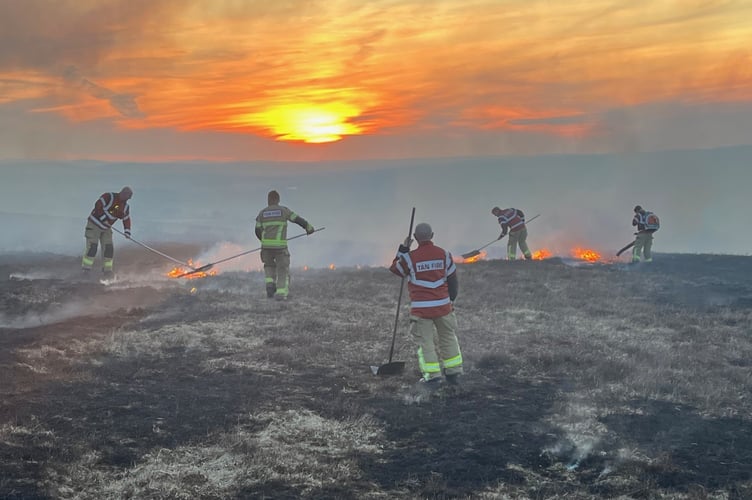
After more than 1,200 wildfire incidents in Mid and West Wales so far this year, fire chiefs are overhauling their strategy to confront a rapidly escalating problem.
Mid and West Wales Fire and Rescue Service (MAWWFRS) has completed a pioneering engagement process designed to shape how it prevents and responds to wildfires in the years ahead. The work brought together operational firefighters, land managers, partner agencies and community representatives in a series of “Balanced Room” workshops aimed at tackling one of the service’s most pressing risks.
Wildfires have increased in frequency this year. They pose significant dangers to firefighters and rural communities, cause lasting damage and place growing strain on already stretched resources.
Figures underline the scale of the challenge. An average of 65 per cent of wildfires in Mid and West Wales over the past decade have been deliberate. Grass fire numbers have fluctuated sharply, with 1,224 incidents recorded in 2022, falling to 671 in 2023 and 381 in 2024 following wetter conditions. However, 2025 has already surpassed those totals, with 1,257 incidents reported to date, marking the highest total in recent years.

The impact is not limited to fire numbers alone. Vehicle collisions linked to wildfire responses rose to 102 incidents in 2024/25, adding further financial and operational pressures. While wet weather in 2024 reduced fire activity, it also led to unmanaged vegetation growth, increasing fuel loads and raising the risk of severe fires during future dry spells.
Across two in-person workshops and a follow-up online session, participants generated and tested a wide range of ideas against core criteria, including firefighter and public safety, legal responsibilities and affordability. From this process, five principles were agreed to guide future decision-making: collaboration and partnership; prevention first; specialist capability and consistency; learning and continuous improvement; and deliverability and policy alignment.
Those principles were then used to refine a long list of ideas into a focused set of options. The final package includes eight core outcomes spanning prevention, protection, response and recovery, supported by a cross-cutting emphasis on improved communications and data sharing.
Proposals include expanding education and behaviour-change work with communities and land managers, better alignment with farming policies to encourage preventative land management, and greater use of technology such as drones, mapping tools and satellite data. Other options focus on improving firefighter welfare and equipment, developing specialist wildfire teams and flexible vehicles suited to rural terrain, and exploring collaborative aerial firefighting capability.
Post-incident recovery also features strongly, with targeted follow-up visits, intelligence gathering and enforcement measures aimed at reducing repeat incidents.
The options have been reviewed by senior leaders and will now be prioritised for inclusion in the Community Risk Management Plan 2040.
Iwan Cray, Deputy Chief Fire Officer for Mid and West Wales Fire and Rescue Service, said: “This process has shown the power of collaboration. By listening to our staff, partners, and communities, we’ve developed practical, innovative options that will strengthen our ability to prevent and respond to wildfires. Together, we can build a safer, more resilient Wales.”
Comments
This article has no comments yet. Be the first to leave a comment.