
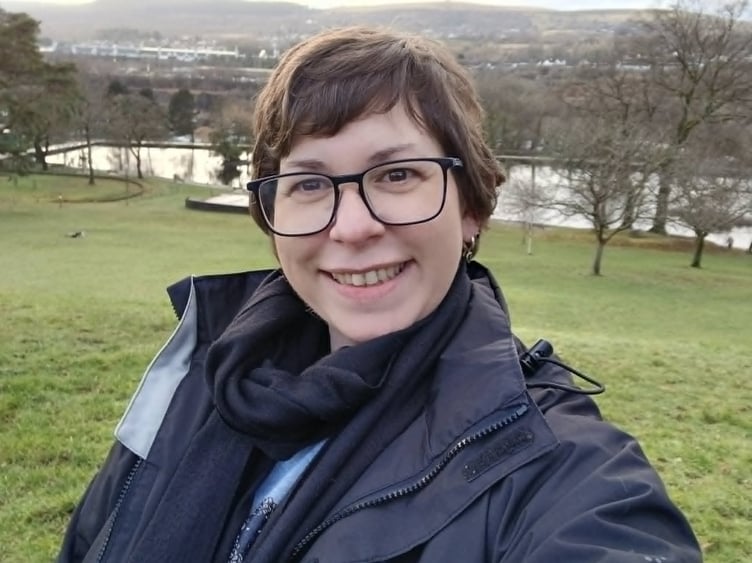
A Brecon woman who was diagnosed with a rare form of lymphoma after developing a lump in her neck has shared her story to raise awareness of the signs of blood cancer.
Elise Griffiths was diagnosed with grey zone lymphoma in 2023 and is now in remission after undergoing several different treatments, including intensive chemotherapy, immunotherapy and a stem cell transplant. She is sharing her story during Blood Cancer Awareness Month in September as part of Lymphoma Action’s Let’s talk lymphoma campaign.
Before her diagnosis, Elise was working as a radiographer after qualifying three years earlier.
“I enjoyed rock climbing, yoga and painting but I mainly spent free time going on adventures with my partner or catching up with friends,” she said.
That changed in April 2023 when Elise woke one morning and discovered a large swollen lump at the bottom of her neck, above her collarbone.
“I was concerned, so I booked an appointment with my GP who thought it might be a cervical rib,” she said. “Looking back, I also had a persistent cough and felt tired, but I brushed my symptoms off at the time.”
Over the following weeks, she developed chest pain which came and went, as well as frequent high temperatures. She returned to her GP and was prescribed antibiotics.
Although the swelling in her neck reduced, a hard lump remained and her doctor agreed that it was a lymph node.
Elise was referred for an ultrasound, but weeks passed without a confirmed appointment.
“Although the chest pains continued, I didn’t go back to the doctor because I didn’t want to bother them,” she said.




At the end of August, Elise began coughing up sputum with blood in it. She returned to her GP, was given more antibiotics and referred for another chest X-ray.
But when the chest pain became worse while she was at work and she began coughing up more blood, she went to A&E.
“I had a chest X-ray, followed by a CT scan of my chest and was sent home from work,” she said. “I can’t thank my colleagues enough for their professionalism and support during such a worrying and stressful time.”
The following day, Elise was asked to return to hospital to discuss the results.
“I was told I had a large mediastinal mass that was likely to be lymphoma,” she said.
After two biopsies of the lymph nodes in her neck, she was diagnosed with grey zone lymphoma, a rare type of high-grade B-cell lymphoma.
Elise was told there was no standard treatment because the condition has characteristics of both Hodgkin and non-Hodgkin lymphoma – hence the name “grey zone”. A PET scan showed she had stage three disease.
She was also told that her planned treatment would affect fertility.
“I cried a lot after being told the planned treatment would make me infertile,” she said.
After having the opportunity to freeze her eggs, Elise began treatment in December 2023.
Her first treatment involved six rounds of EPOCH-R chemotherapy, an intensive regime which included a 96-hour infusion and long stays in hospital.
“After the first couple of rounds, I was surprisingly OK and just felt constantly hungover,” she said. “But after more rounds, I felt increasingly unwell. I was extremely weak, felt sick and had numbness in my fingers.”
She also found losing her hair particularly difficult.
“I was not prepared for how rapidly my hair would fall out either,” she said. “Two weeks after my first cycle of chemo my head started to feel tingly, and I noticed hair on my pillow.”
When she tried to wash her hair, it began falling out. She asked her father to shave her head.
“It was emotional but liberating to take back some control,” she said. “My advice to anyone about to have this chemo is to be brave and shave your head; the trauma of the fallout is not worth holding on to your hair for a little longer.”
Despite the treatment, a small area of disease remained in her armpit.
Elise was given another form of chemotherapy in an attempt to put her into remission before a stem cell transplant. But the treatment brought further side effects, including neuropathy, tinnitus, weight gain, lightheadedness and a significant drop in her mood.
A PET scan then showed that the disease had progressed.
“The lymph node in my armpit had grown and there was new disease in my chest,” she said. “The stem cell transplant was cancelled, and my case was taken to a wider MDT meeting to discuss a new treatment plan.”
Her third line of treatment was brentuximab and nivolumab, a form of immunotherapy.
This treatment was more manageable, requiring a one-day hospital visit every three weeks.
“I had hardly any side effects apart from fatigue and my hair actually grew back!” said Elise.
After four cycles, a PET scan brought the news she had been hoping for. It showed she had achieved complete remission in January 2025.
“I cried with happiness!” she said.
Elise was later given the choice between an autologous stem cell transplant, using her own stem cells, or an allogeneic transplant using donor cells. She chose to have an autologous transplant.
“I liked to think of this process as pressing the ‘reboot’ button on my body,” she said.
The transplant involved another chemotherapy regimen called BEAM, designed to destroy any remaining disease and prepare her body to receive her stem cells.
The treatment brought its own challenges, including severe mouth pain.
“As it started to work, my mouth became extremely sore, and eating, brushing my teeth and talking became painful,” Elise said. “My mum made sure I had plenty of ice pops in the hospital freezer; they were a game changer.”
Her stem cells were then returned to her body in a process she compared to a blood transfusion.
“The day I got my stem cells back was extremely happy,” she said. “I finally felt like I was going to overcome lymphoma!”
After some temperature spikes and antibiotics, Elise was able to return home to recover.
She is now back at work and looking towards the future.
“As I write this, things are going well,” she said. “I am back at work, hoping to further develop my professional training and manage a better work-life balance.”
She is also enjoying exercise again and hoping to return to yoga.
“My hair is growing back and I’m starting to feel like me again. I hope to start house hunting very soon too.”
During her treatment, Elise found support through Lymphoma Action, using its website to learn more about the disease and joining its Facebook support group.
Elise and her mother have also started a weekly social line-dancing evening to raise money for Lymphoma Action, lymphoma and stem cell charities and cancer services.
Now she wants other people to be aware of lymphoma and to feel confident about seeking medical help if they are concerned.
“Looking back with hindsight, I should have gone back to the doctor earlier and pushed harder to be seen as my symptoms worsened,” she said. “I want people to have the confidence to advocate for themselves and hope my story will help to encourage them to do that.”
Lymphoma Action is the UK’s leading charity dedicated to lymphoma and is using Blood Cancer Awareness Month to raise awareness of the disease and support people affected by it.
Comments
This article has no comments yet. Be the first to leave a comment.