

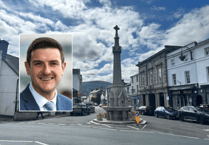
PHIL George, chair of the Arts Council of Wales, came to Crickhowell last week (Tuesday, November 7) to open an exhibition of paintings by the renowned Welsh artist John Uzzell Edwards in the Tower Gallery.
John died three years ago, and the exhibition has been curated by his widow Mary, who recently moved from their home near Ystradgynlais to Brecon.
Famous for his very large canvases often inspired by the pattern-making of ancient Welsh quilts and the ‘carpet-designs’ of Celtic manuscripts, most of John’s recent works are too large to get up the stairs into the Tower Gallery, but Mary selected for the gallery many of his smaller paintings, drawings and sketches which reveal the vivid imaginative powers of her late husband.
“Some of these works can break your heart or crease your sides with laughing,” Phil George told a crowded gallery at the opening. Before embarking on his more abstract canvases John explored images in his paintings taken from old photos of Welsh weddings, choirs and family groups.

A very large example of these family groups is hanging on permanent display in Cyfarthfa Castle, and in the Tower Gallery lively sketches relating to such pictures can be seen. John was deeply rooted in Wales, said Phil George.
“He loved the faces of Wales and was proud to be a Welsh artist.”
John was born in the mining village of Deri, in the Rhymney Valley, and drew and painted from the age of 10. His father, a miner, died in an underground accident and, although he would have liked to have gone to art college, John had to seek work on leaving school. He found it as an engineering draughtsman.
Later he would say he was glad to have “avoided art school”, gaining other experience which proved valuable later on. Living in Merthyr Tydfil he worked on a series of drawings of the Valleys, and after moving to Tenby painted skeletal barges, dead seagulls and buildings by the sea. A Granada Arts Fellowship took him to the University of York to paint, and a Leverhulme European Research Award gave him time to study and work in Rome.
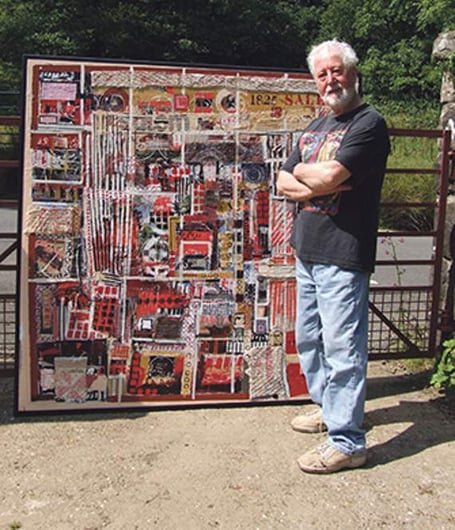
The Tower Gallery exhibition is in two halves, with many small, exploratory sketches relating to his early works. There are also some of his larger later works including in the downstairs hallway (it was too big to take up the stairs) a high impact picture entitled ‘Exploding Quilt’. This is one of his last paintings. In it he brings images from many Welsh quilts together and spins them in a seemingly uncontrolled vortex. The surface is a mixture of collage and paint with underlying layers, many of them partly hidden. John loved the colours and patterns of early Welsh quilts. He wrote in 2009, “I found my first quilt in an antique fair in Builth Wells, rolled up in a bundle. I could only see a corner of it, but I knew I had to have it for my painting. The structure in these quilts is amazingly complicated; the colours and texture a challenge for a painter – totally inspiring”.
After that John and Mary went every year to the antique fairs at the Royal Welsh Showgrounds, buying all the quilts they could discover. “The first quilt still smells of Llanelwedd and the animals in the showground,” says Mary.
Ancient relics retrieved by archaeologists from the Crannog in Llangors Lake also inspired the artist, and there is a painting in the show which takes part of its design from a small enamelled hinge found near the Llangors settlement.
Phil George told his Tower Gallery audience that in the ‘Exploding Quilt’ image “the Welsh quilt becomes a Hadron Collider, in which the Big Bang and the atomic structure of John’s imagination is revealed. He had a long life lived devoted to painting and in search of form.
His whole life was a challenge – a challenge to live in the power of the imagination. And in the ‘Exploding Quilt’ the exhibition goes out with a Big Bang”.
The exhibition continues until January 6. The Tower Gallery is open from Wednesday to Saturday, 10am-5pm. Works by the Tower Gallery Artists’ Collective are also on show.