
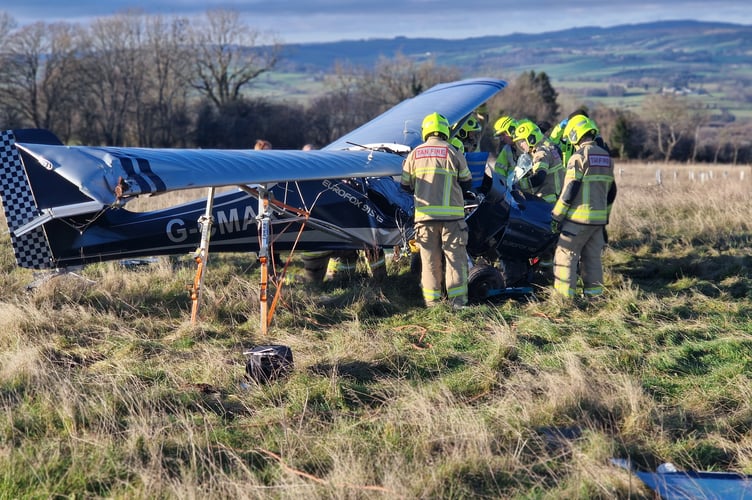
A new report released by the Air Accidents Investigation Branch has revealed the cause of a light aircraft crash in December 2025.
On December 27, Mid and West Wales Fire and Rescue Service crews from Talgarth and Crickhowell fire stations were called to the incident at 11.38am, where they pulled the sole pilot, an 81-year-old man, from the wreckage of a 2021 Eurofox 2K, G-CMAX.
The crash caused damage to the propeller, cockpit and wing.
The investigation into the crash revealed that immediately after take-off, the aircraft, which was towing a glider, rolled unexpectedly to approximately 60 degrees left wing down.
The tug aircraft turned left and touched down within the airfield boundary before becoming airborne again. Control of the aircraft was then lost and it struck the ground in an adjacent field.
Investigators say the wind at the time of the accident was "fully across the runway" and "may have been above the crosswind limit of the aircraft".
Turbulence immediately before the accident also suggested that the air was "unstable and is likely to have been so during the accident flight, probably causing the initial roll and subsequent loss of control".
Talgarth Gliding Club has since improved its weather reporting system, providing more accessible and accurate wind measurements to pilots, while also improving the safety culture at the club in response to the crash.
Investigators at the AAIB said the pilot had intended to take off east into the wind, but that plan was changed when the launch area was wet and too boggy to operate from.
The pilot then decided to take off from another runway, operating from the north-westerly runway, following a conversation between the duty instructor and the tug pilot.


The aircraft was attempting to launch a glider, but moments after becoming airborne, the tug aircraft was seen "rocking from side to side".
The report says: "The tug aircraft turned approximately 60° to the left (downwind), increasing the tailwind component that it was experiencing. The main landing gear tyres touched the ground briefly, whilst the aircraft was tracking towards a line of trees.
"The aircraft became airborne again and was observed to be climbing 'almost vertically' as viewed from the launch point. The aircraft passed over the trees and a small hangar, the left wing dropped, and the aircraft descended rapidly into a field just outside the airfield boundary."
The pilot of the tug aircraft was an experienced glider and powered aircraft pilot who had held a licence for 45 years and had clocked up 2,249 flying hours, the investigation states.
He had also completed more than 12,000 aero-tow operations and had been a gliding instructor since 1978, with more than 1,300 hours of glider instruction.
The aircraft was owned and operated by the gliding club and used solely as a glider towing aircraft.
The Eurofox is a popular glider tug aircraft, with more than 50 operating in the UK for this purpose. The aircraft has a maximum crosswind limit for take-off of 15kt and a tailwind limit of 4kt.
Talgarth Airfield is located close to the Black Mountains in Wales, which affects the local weather.
Conditions at the airfield are "very changeable and can be challenging at times, due to the nature of the localised weather".
The club uses a variety of sources to determine weather conditions, including websites providing forecasts primarily to mountain walkers, as well as Met Office aviation websites.
There is a windsock positioned north of the east-west runway that is visible from most locations on the airfield, including the starting position of G-CMAX's take-off roll.
A duty instructor with local knowledge and experience assesses flying conditions.
The gliding club has recognised the challenges of operating from the airfield, so a site briefing pack and video are available on the club's website to highlight these. It is compulsory for any pilot wanting to operate from the site to have reviewed this material.
A briefing is conducted by the duty instructor every morning before the day's flying, and this includes the prevailing weather conditions and threats for the day.
The conditions for gliding were favourable that day, and the focus on the goal of towing the glider for its flight might have prevented the pilot from pausing to reflect on the hazards identified in BGA and CAA guidance caused by the crosswind and turbulence.
After the accident, the club began to instil a culture whereby pilots asked themselves: "Should we fly, rather than can we fly?"
They were also encouraged to ask: "What's trying to catch me out today, what mistakes would make that more likely, and what am I going to do about it before launch?"
The club also introduced a live wind indicator on its website, accessible to all club members, which shows a mean two-minute wind and the maximum 10-minute gust.
It also displays headwind, tailwind and crosswinds for all three runways.
Comments
We've recently changed our login process. If you have an account for commenting, you will need to re-register on the login window.
This article has no comments yet. Be the first to leave a comment.