
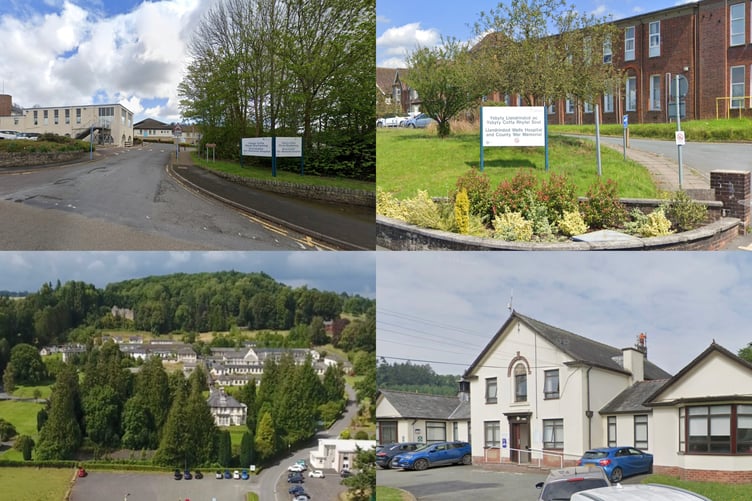
Powys Teaching Health Board is being asked next week to take the next step towards a major reshaping of NHS services across the county.
But what do the options actually mean? We’ve taken a closer look at the 252-page document to work it out.
The board papers published ahead of next Wednesday's meeting give a much clearer picture of what could change at hospitals across Powys – including the number of inpatient beds, where they could be provided and which areas could lose urgent care services.
Before we get into it, it is important to stress that none of these changes have been decided.
The health board will decide next week if the proposals are ready to go out to public consultation - which would begin on October 5 and last for 14 weeks.
Fewer community hospital beds
There are currently 146 community inpatient beds across eight hospital sites in Powys, although some services are operating under temporary arrangements.
Two options have been put forward for the future of physical health inpatient care.
The first would reduce inpatient provision to around 90 beds across three sites – Newtown, Llandrindod Wells and Brecon. That would mean inpatient care would no longer be provided at Machynlleth, Welshpool, Llanidloes, Bronllys or Ystradgynlais.
The second option goes further. It would reduce the number of inpatient sites to two – Newtown and Brecon – with around 60 beds. Under that option, Llandrindod Wells would also lose its community inpatient beds.



The health board says the reduction in beds would be accompanied by a major expansion of care provided outside hospital, including Hospital at Home, rehabilitation, reablement, district nursing and rapid response services.
The idea is that more people who might previously have been admitted to a community hospital could instead be cared for at home or in the community.
But the board's own assessment acknowledges that fewer inpatient sites would mean longer journeys for some patients, relatives and carers.
Under the three-site option, the average travel time for community inpatient care is modelled to increase from 11 minutes 56 seconds to 23 minutes 50 seconds.
Under the two-site model, the health board identifies particularly significant access concerns for areas including Llandrindod and Rhayader, Builth and Llanwrtyd and communities in Radnorshire.
The papers also make clear that the reduction in beds could not simply happen first and the community services follow later.
The health board says the enhanced community services would need to be sufficiently developed before inpatient capacity was reduced.
Urgent care could also be concentrated
There are currently Minor Injury Units at Welshpool, Llandrindod Wells, Brecon and Ystradgynlais.
The two urgent care options both propose establishing larger Urgent Care Centres at Newtown and Brecon.
These would operate from 8am to 8pm, seven days a week, with a wider range of assessment, treatment and diagnostic services than the existing MIUs.
But there are two versions of the plan.
Under Option UC013, a Minor Illness and Injury Unit would remain at Llandrindod Wells, alongside the two UCCs at Newtown and Brecon. The Llandrindod unit would operate from 8am to 8pm, seven days a week, with X-ray available seven days a week across the three sites. Welshpool's MIU would remain until the new Newtown UCC opened, before closing.
The second option, UC013ii, would have just the two UCCs at Newtown and Brecon. That would mean no MIU at Llandrindod. X-ray services would still be available at Llandrindod under this option, five days a week, while Newtown and Brecon would have seven-day X-ray provision.
The health board's assessment says the two-site urgent care option would be more financially and workforce efficient, but would create greater access problems, particularly in Mid Powys. It identifies Llandrindod and surrounding areas as a concern.
Mental health service changes
There is one option being put forward for adult mental health inpatient services.
It would bring all adult functional and older adult organic inpatient services together at a site at Bronllys, or a new site in the Bronllys and Brecon area.
The papers say the inpatient mental health ward at Brecon, Crug Ward, has been temporarily closed since March 2020.
The health board says this would create a single centre of excellence with a larger multidisciplinary team and more specialist expertise.
However, it would mean the permanent closure of inpatient mental health services at Llandrindod Wells, Brecon and Ystradgynlais.
The board's own modelling shows the average journey for mental health inpatient care would increase from 38 minutes six seconds to one hour five minutes 21 seconds. The proportion of households within a 45-minute journey would fall from 63.8 per cent to 34.1 per cent, based on private transport.
The health board says the increased travel would be balanced by greater investment in community mental health services, crisis support and alternatives to admission.
What happens next?
The board will meet next Wednesday (September 16) to decide whether the plans are ready to go out to public consultation.
If approved, the consultation is due to begin on October 5.
Comments
We've recently changed our login process. If you have an account for commenting, you will need to re-register on the login window.
This article has no comments yet. Be the first to leave a comment.