
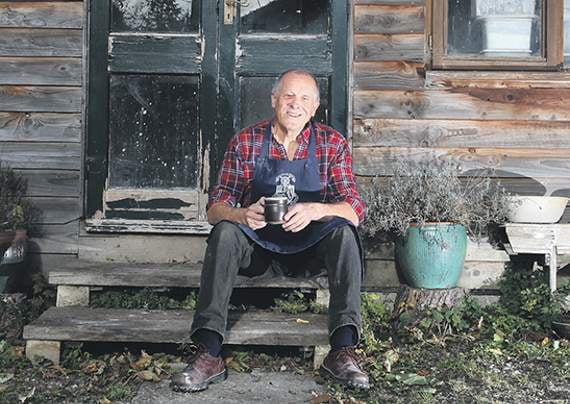
FINDING Jason Braham’s pottery studio is a tricky task, involving as it does, travelling into a remote part of Radnorshire about a mile or two outside Dolau.
You have to pass through at least one farm before you find his home, studio and workshop within the grounds of another farm.
Jason, who spent 35 years as a teacher, has found contentment in his retirement, building up his hobby of 40-plus years making every kind of pot, plate, bowl and cup you can imagine. He uses a technique called salt glazing and describes himself as the northernmost of the South Wales Potters. He has been dabbling with pottery since 1972, juggling it with his career in teaching. However it is only since retiring from working in education that Jason has been able to develop his interest.
He built his kiln in 2005 and committed himself to making pottery full time in 2007 when he set up the appropriately named Far Hall Studio.



His website carries a detailed catalogue of the salt-glazed stoneware that Jason makes but anyone who wants to see the quality of his work as well as the work of other South Wales Potters can do so at an exhibition being held at the Cric Studio in Beaufort Street, Crickhowell.
The exhibition which features the work of 28 potters continues until October 29.
As anyone visiting the exhibition in Crickhowell will see, the potters of South Wales don’t all make pots. There is a tremendous range of sculptural work, both figurative and abstract. Nor are all the “pot pots” shaped on a wheel like Jason’s. Some potters prefer to work by assembling by hand.
There are over 200 members of South Wales Potters, who may be full-time makers, in education, hobbyists and some who describe themselves as ‘just enthusiasts’. The group meets up for demonstrations and studio visits, to exchange ideas and to enjoy each other’s company.
Salt glazing, which is Jason’s speciality, was first practised in the Rhineland in the Middle Ages and was then copied by British potteries in the 17th and 18th centuries.
It continued to be practised industrially until well into the 20th century. It involves throwing salt into the fireboxes of a wood, oil or gas fired kiln heated up to temperatures of 1250 degrees centigrade and above. The sodium in the vapour released combines with the silica in the clay to turn the pot’s surface into a glaze.
Jason says: “The core of my work is a range of ‘standard ware’, though it is the nature of salt-glaze that no two pots are the same, and in any case I give myself a fair bit of freedom to vary a shape. Different clays give different colours and textures. I also make glazes from mixing wood ash and clay. I’m sure there is plenty of glaze potential in stone dust from the local quarries; I just need lots more time to experiment.”
He adds: “My pots are all thrown on a wheel. The next day they may be ‘turned’, which is a bit like using the wheel as a lathe, and handles are pulled on them. Another day and they’ll be dry enough to dip in ‘slip’ (liquid clay) and decoration will be wiped or cut through the slip layer. When bone dry they’ll be ready for the kiln and the salt glaze.
“I must be about the most northerly of the South Wales Potters; a day’s walk up the Offa’s Dyke and I’d be a North Wales Potter for sure. I began potting full time here in 2007 after a 35-year career in teaching. I draw inspiration from traditional country pottery, following the examples of Bernard Leach and, especially, Michael Cardew in the early decades of the last century, who drew attention to what was by then a dying craft. The old country potteries were naturally established where suitable clay could be quarried; they were producing pots in quantity to meet the everyday needs of the population.
“The modern studio potter is less likely to be looking for clay on site than for a place with enough space for a workshop and kiln and far enough away from neighbours not to disturb them with clouds of smoke and, in my case, salt vapour. Rural Wales has provided that space for a good number of us.”
Jason says he is more than happy for people to visit his studio to see where he works and maybe buy some of his wares but he asks that people contact him via his website, www.jasonbraham.com, first – not least because they will probably need directions. “Being somewhat remote, the satnav is unreliable,” he says.
Details of the South Wales Potters exhibition in Crickhowell can be found on their website www.southwalespotters.org.uk.