

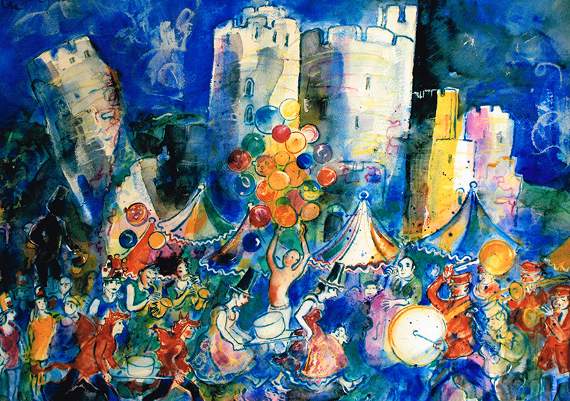
Having celebrated his 80th birthday last year with a one-man exhibition in the Tower Gallery, Crickhowell, Brecon-based painter and printmaker Robert Macdonald is following up this year with an 81st birthday exhibition of some new and some old work.
Robert, who became the first president of the Royal Watercolour Society of Wales last year, exhibits widely in Wales and abroad.
He was born in 1935 and, during World War II, was evacuated to live for some time on a Somerset farm. Ever since his Somerset days Robert has been fascinated by rural life, and included in his new show is a series of recent ink and watercolour paintings of Welsh farm sales, shearing scenes and confrontations with bulls. He has lived in Wales since the 1980s, for many years occupying an isolated cottage with no road access on the edge of the Penpont estate.
He is very much at home in Wales. The rural life reminds him not only of Somerset but also of New Zealand. At the end of the war Robert went with his family to live there, and he spent the second half of his childhood and began work in New Zealand, training first of all as a newspaper reporter. He returned to Britain in 1958 to study art at the London Central School, and he found his newspaper training vital to keep him afloat in London. Although continuing to paint, he gained his living throughout the 1960s as a journalist in Fleet Street. He gave up journalism in 1976 when he went as a mature student to study in the Painting School of the Royal College of Art. Since then he has concentrated on a career as an artist.


His early years in New Zealand left a lasting impression on his work. His colours are much brighter than those associated with the northern hemisphere and his imagination was fired as a boy by the lives and myths of the Maori people.
In the 1980s he returned to New Zealand to write and illustrate a book on his early experience of that country and on the more recent struggles of the Maori to reassert their cultural independence. His book, ‘The Fifth Wind’, championing the cause of the Maori land movement, was published by Bloomsbury in 1989. In recent years he has taken some of the linocut images in ‘The Fifth Wind’ to create composite coloured images and a number of these works are included in the Crickhowell exhibition. His linocuts play with both Welsh and Maori myth. One Welsh legend in particular – that of the lake maiden of Llyn-y-Fan Fach - catches his imagination and he has explored it in paintings, etchings and woodcuts.
He is a director of the Swansea Print Workshop and was sent by Swansea a few years ago to work in Scotland for a period, in the Edinburgh Print Workshop. This gave rise to a whole new series of etchings inspired by his family’s Highland Scots history. They are to be seen in the Tower Gallery, along with etchings commemorating last year’s Dylan Thomas centenary.
Before being evacuated to Somerset as a boy Robert lost his family home in a German bombing raid, and his etchings celebrating the centenary focus on the poet’s prose work ‘Return Journey’ in which Dylan Thomas talks of returning to Swansea after the Blitz and exploring the destroyed city centre. In Robert’s prints the ghostly shapes of German aircraft circle over the city ruins, as they have circled for over 70 years in the artist’s memory.
The exhibition is open until May 7.